


Guides
Thermal Imaging Sensors for Ukraine in 2026: Demand, the Supply Gap and Who Can Close It
Ukraine uses 100,000+ thermal cameras a month and makes no sensor dies. Demand, China's licences, non-Chinese prices and how suppliers can sell there.

A component maker from NATO and allied countries has 4 routes into Ukraine: supply, licensed production, a joint programme or a nearshore plant.
Supplying Ukrainian manufacturers is the fastest route. Our research puts first revenue at 3 to 9 months, usually without a Ukrainian company.
Licensed production in Ukraine raises your buyer's local content. Your own production in Ukraine starts at about USD 6 million and takes 12 to 24 months.
In joint programmes, the partner government funds the foreign side. UNITE Brave NATO offered up to EUR 1 million per joint project in its first call.
A nearshore plant serves Ukrainian assembly lines from outside Ukraine. EU-funded procurement caps components from outside the EU, EEA EFTA and Ukraine at 35% of component cost.
A component maker from NATO and allied countries can enter Ukraine by 4 routes. It can supply Ukrainian manufacturers directly or license production to a Ukrainian company. It can also join a joint programme with a Ukrainian partner or open a nearshore plant that serves Ukrainian assembly lines. Supply brings revenue first. The other 3 routes take longer and add local content, grant money or a place inside EU origin rules.
This guide looks at entry from the supplier's side. It draws on our research on Ukraine's Chinese Component Gaps, built by our research team from public sources up to 14 September 2026. The time and cost figures come from our earlier research, Entering Ukraine. For the 7 component gaps China still holds, start with our guide How to Sell Drone Components to Ukrainian Manufacturers in 2026.
The right route depends on what you need first: revenue, local content, funding or EU origin.
Route | What you do | Your own Ukrainian company | Time and money |
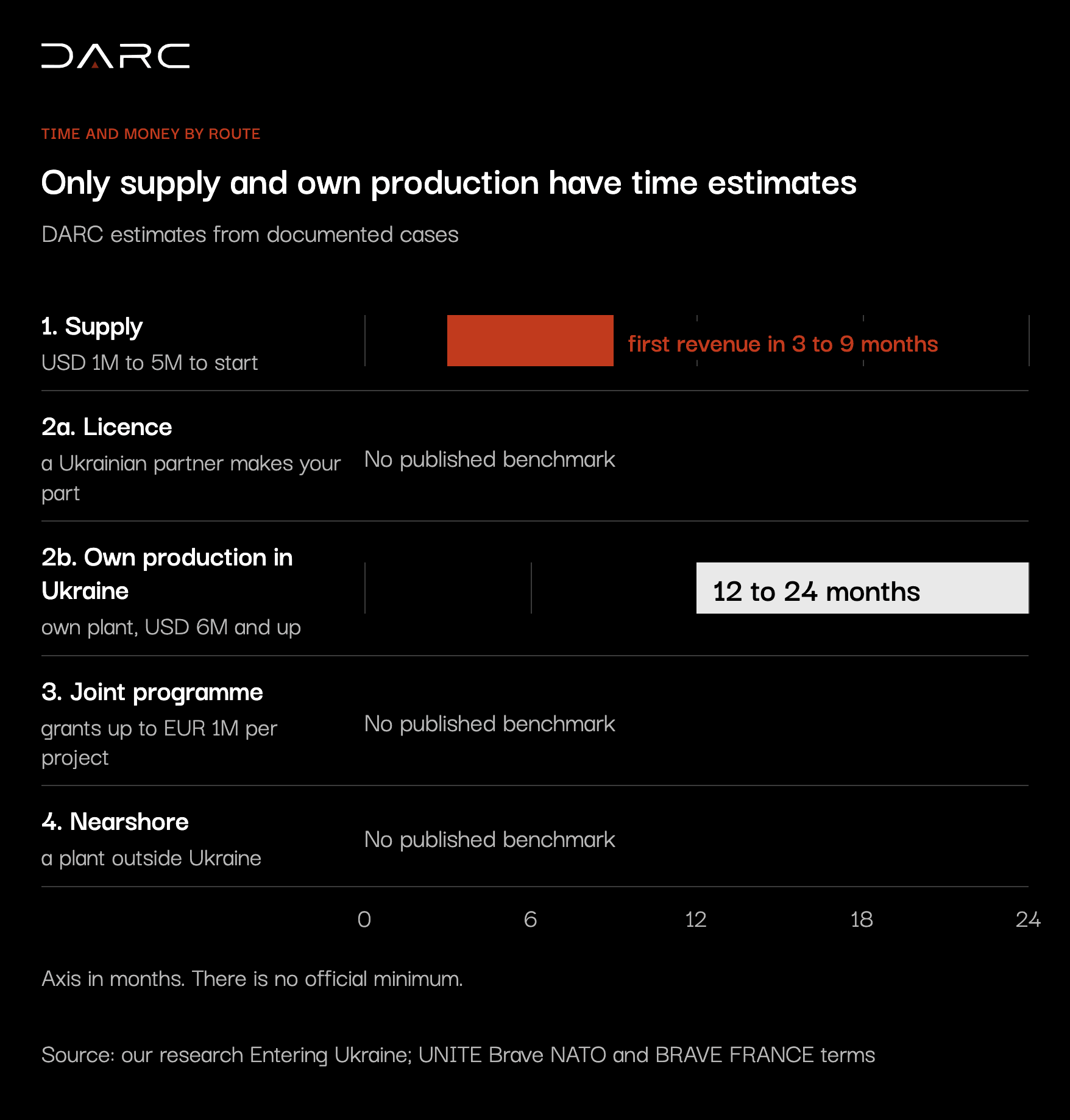
1. Supply | Sell parts to Ukrainian manufacturers | Usually not needed | USD 1 million to USD 5 million to start, first revenue in 3 to 9 months |
2. Licence | A Ukrainian partner makes your part under licence, or you form a joint venture | Needed for a joint venture in Ukraine or your own plant | Licence: no published benchmark. Own production in Ukraine: USD 6 million and up, 12 to 24 months |
3. Joint programme | Develop or produce with a Ukrainian company under a government programme | Not needed: you pair with a Ukrainian company | Grants of up to EUR 1 million per joint project (UNITE Brave NATO) or per grant (BRAVE FRANCE) |
4. Nearshore | Make the part outside Ukraine and ship it to Ukrainian assembly lines | Not needed | No published benchmark |
The capital and time figures are our estimates from documented cases. There is no official minimum.
What it is. The Ukrainian manufacturer is your customer. You sell parts, sub-components or materials, and it builds them into its own products.
What it requires. A product, a delivery contract and, for listed items, an export licence. The EU's general export authorisation EU001 does not cover Ukraine, so listed dual-use items shipped from the EU need a licence.
Time and money. Entering Ukraine puts the start at USD 1 million to USD 5 million, with first revenue in 3 to 9 months. Of the 4 routes in Entering Ukraine, supply and direct sales to military units are the only 2 that bring Ukrainian revenue inside a year.

The price to beat. Imported drone parts have been free of VAT and import duty since June 2023. Your part and a Chinese one enter on the same terms, so the Chinese price is the price to beat.
Payment terms. Since 28 April 2026, drone makers can take advances of up to 70% on DOT-Chain Defence, the state online marketplace. Agree who funds stock before the first order.
Who pays for origin. Our research found no public tender that pays more for China-free parts. Origin pays in specific channels, covered in Route 4.
→ Deep dive: What Pays for China-Free Parts in Ukraine
The main risk. Entering Ukraine names it: a supplier becomes captive to one customer's balance sheet. Check your buyer first with our guide How to Find and Validate a Ukrainian Defence Manufacturing Partner.
Demand for a switch. In a poll of 30 Ukrainian manufacturers by the Snake Island Institute and the Ukrainian Council of Defence Industry, 76.7% said they would abandon Chinese sourcing if competitive alternatives became available. In our conversations with Ukrainian makers, the wish to switch comes up almost every time. What holds them back is doubt that a partner can match the price, quality and volume.
What it is. A Ukrainian company makes or assembles your part in Ukraine under your licence. In a joint venture, you also share ownership of the Ukrainian company that makes it.
Why buyers value it. A weapon needs at least 50% local production cost to join Ukraine's Weapon of Victory list. Makers on that list can get state contracts of 3 to 10 years. An imported part lowers the local share, from any country. A part made in Ukraine under licence raises it.
Examples. In July 2026, Czech engine maker PBS and Ukraine's Airlogix signed a memorandum on licensed production of PBS small turbine engines in Ukraine. The plan starts with assembly. Croatia’s Orqa and the Ukrainian drone maker General Cherry have started work on an underground plant in Ukraine for drone electronics and components, Militarnyi reported in April 2026.
Time and money. Your own production in Ukraine starts at about USD 6 million and takes 12 to 24 months to first revenue, according to Entering Ukraine. It needs a Ukrainian company, a site, permits and physical protection. Local content can grow in steps: Quantum Systems moved from assembly to full local fuselage production in about a year.
What a Ukrainian company opens. Brave1’s own grants of up to UAH 8 million go only to companies registered in Ukraine. Defence City, Ukraine's tax regime for defence makers, also needs a Ukrainian legal entity. Its residents get an export permit in 15 days, against 6 months or more through the Cabinet route.
The main risks. Plan for physical protection of the site. Profit that gets Defence City tax relief must be reinvested in set uses, such as equipment, new technology and weapons R&D, or the tax falls due.
Send us a message with what you make, and we will tell you which route fits your part in Ukraine.
What it is. You develop or produce with a Ukrainian company under a government programme. The programme sets the rules and brings part of the money.
Build with Ukraine. Launched in June 2025, it sets up joint ventures of Ukrainian and Western companies with production lines in European countries, according to OSW. European partners finance serial production for Ukraine's needs. Ukrainian companies bring know-how and integration expertise. Germany, the UK and Denmark are the most developed partners so far.
Quantum Frontline Industries, a joint venture of Germany's Quantum Systems and Ukraine's Frontline, plans at least 10,000 drones in Germany in 2026 for Ukraine. Stages differ: OSW notes that Polish-Ukrainian agreements under the programme had not been implemented by April 2026.
Joint grant programmes. In June 2026, Ukraine's government set common rules for its joint grant programmes with partner countries. Ukraine and each partner pay in equal shares, and foreign developers can take part. In these programmes, the foreign company is paid from the partner’s share, our research found.
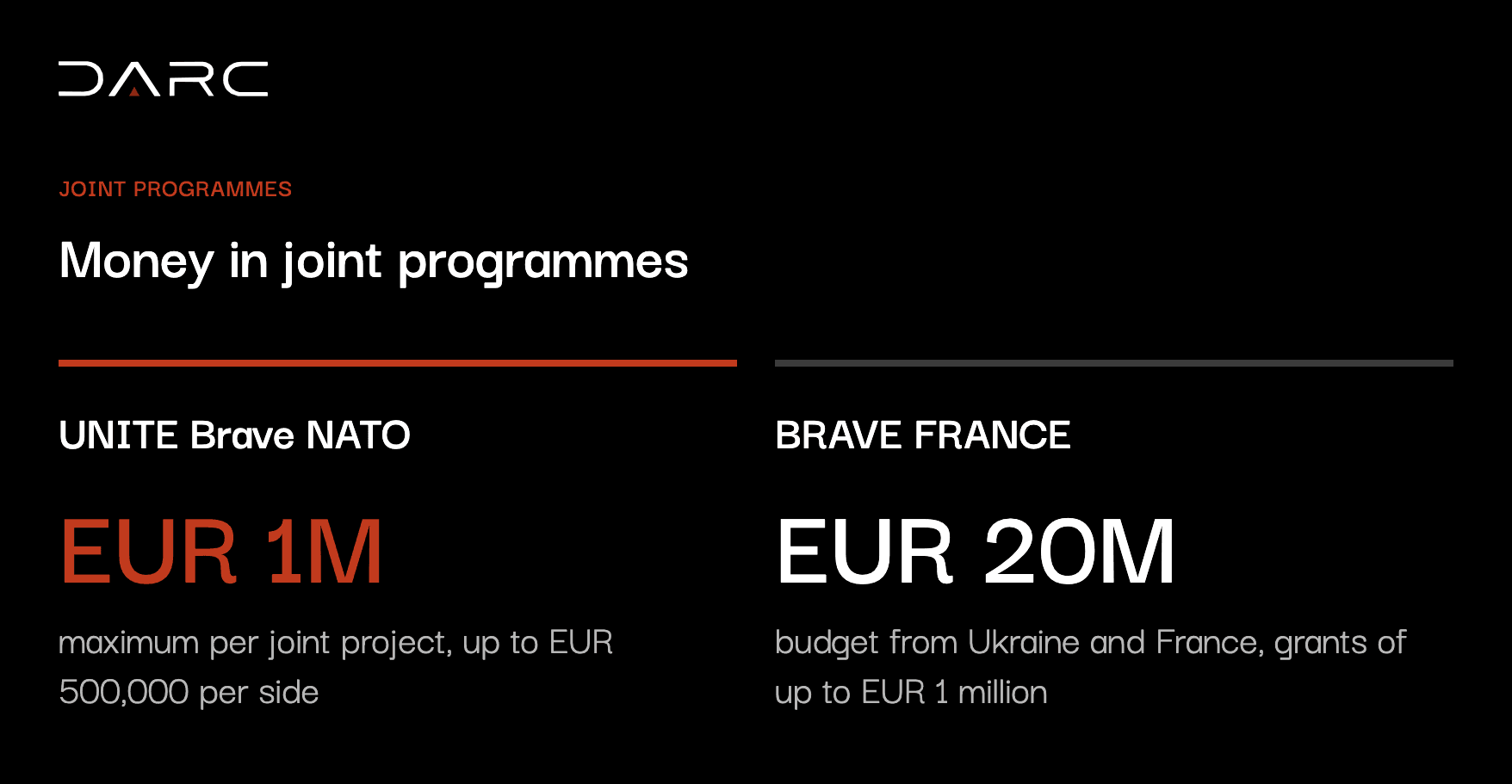
UNITE Brave NATO. The first call had a joint budget of EUR 10 million, for teams of 1 Ukrainian and 1 NATO-member company. Each side could get up to EUR 250,000 or EUR 500,000 depending on the topic, so a team could get up to EUR 1 million. Brave1 funds the Ukrainian company, and NATO funds the allied company through its Comprehensive Assistance Package for Ukraine. Expressions of interest closed on 3 August 2026, and no winners had been published by 21 October 2026.
BRAVE FRANCE. Ukraine and France put in EUR 10 million each, and a grant can reach EUR 1 million. The first competitions were planned for September 2026, but we found no published call by 21 October 2026.
BraveTech EU DefTech Forges. Start-ups and SMEs based in the EU, Norway or Ukraine apply directly, for prizes of up to EUR 120,000 per winning team.
Germany, Lithuania and Norway. Programmes with Ukraine have been announced.
Donor-funded contracts. Under the Danish model, a partner government pays selected Ukrainian manufacturers directly. A component supplier reaches that money through the contract holder.
Ukrainian Unmanned Technologies (UUT) designs the RAVLYK (UMP-2) ground robot. The robot is in serial production at several Ukrainian defence plants, according to Haulotte. On 17 June 2026, at Eurosatory in Paris, UUT signed an industrial partnership with Haulotte, a French maker of lifting platforms.
UUT keeps the technology. Haulotte provides production, logistics and service capacity and supports the robot's life cycle. The work follows the Build with Ukraine programmes, Forbes Ukraine reported. MergeWave Capital, which powers DARC, represented UUT, according to the same report.
Production at Haulotte's plant in Lorette, France, is planned to start in January 2027, French regional media reported in August 2026.

UUT and Haulotte sign their industrial partnership agreement, June 2026.
What it shows a component maker. Haulotte came from outside defence. It entered with what it already had: plants, a supply chain and service. The Ukrainian partner brought a design already in serial production.
What it is. You make the part outside Ukraine, close to it, and ship it to Ukrainian assembly lines. You need no Ukrainian company.
Who does it. Taiwanese drone makers have expanded production in Poland and Lithuania as Ukraine cuts its reliance on Chinese parts, DIGITIMES reported in May 2026.
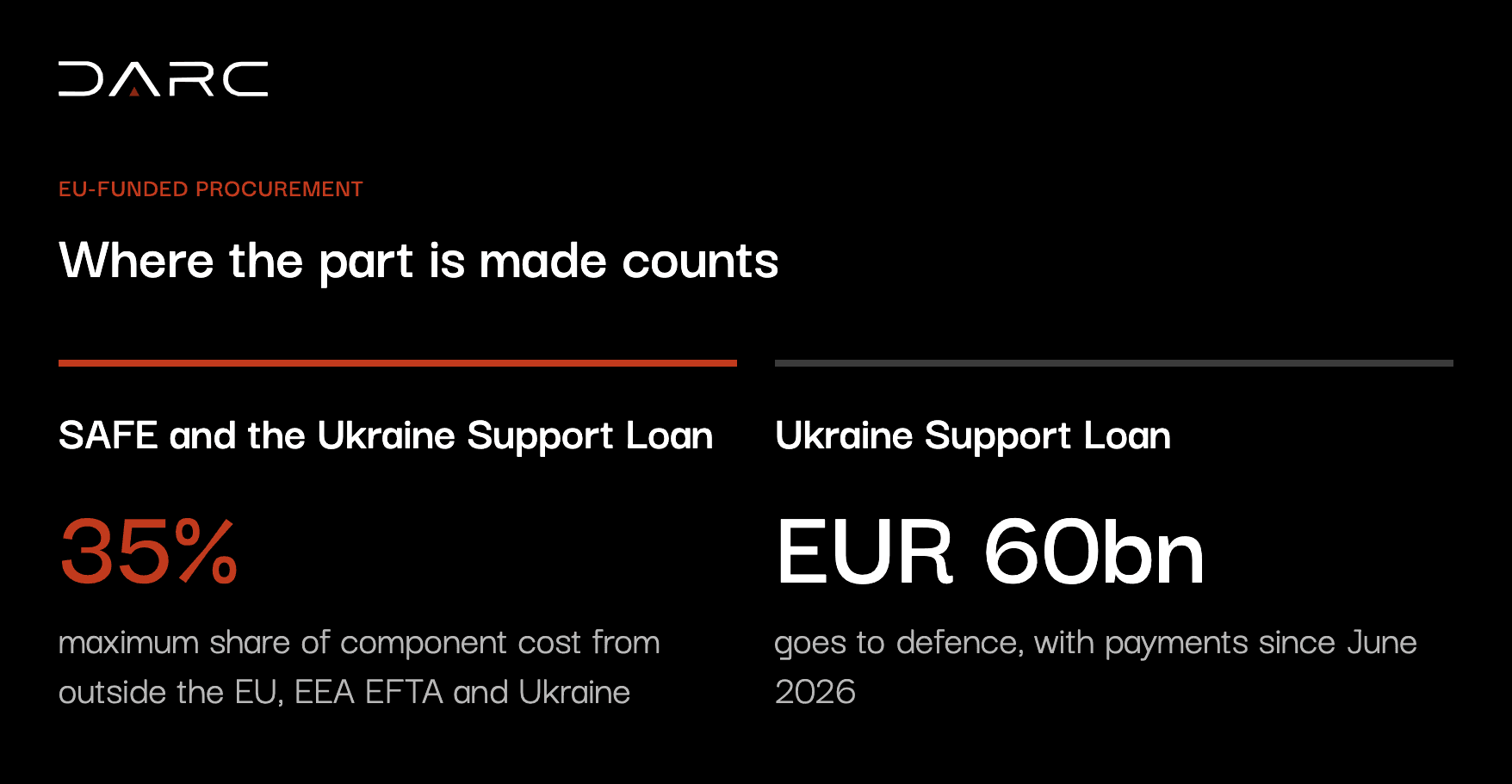
Why location matters. EU procurement financed by SAFE loans caps components from outside the EU, EEA EFTA and Ukraine at 35% of estimated component cost. The EU's Ukraine Support Loan applies the same cap, with exceptions for urgent needs. EUR 60 billion of that loan goes to defence, with payments since June 2026.
A maker based in the EU under non-EU control can stay eligible for loan work after investment screening or security guarantees, our research found.
US rules. Section 848 of the US FY2020 NDAA bars the Department of Defense from buying certain drones. These include drones with flight controllers, radios, data links, cameras or gimbals made in China, russia, Iran or North Korea. Since Ukraine launched its controlled export mechanism in July 2026, these rules apply to any Ukrainian maker that wants to sell drones to the US Department of Defense.
What is still unknown. Our research found no public benchmark for the cost or timing of a nearshore plant.
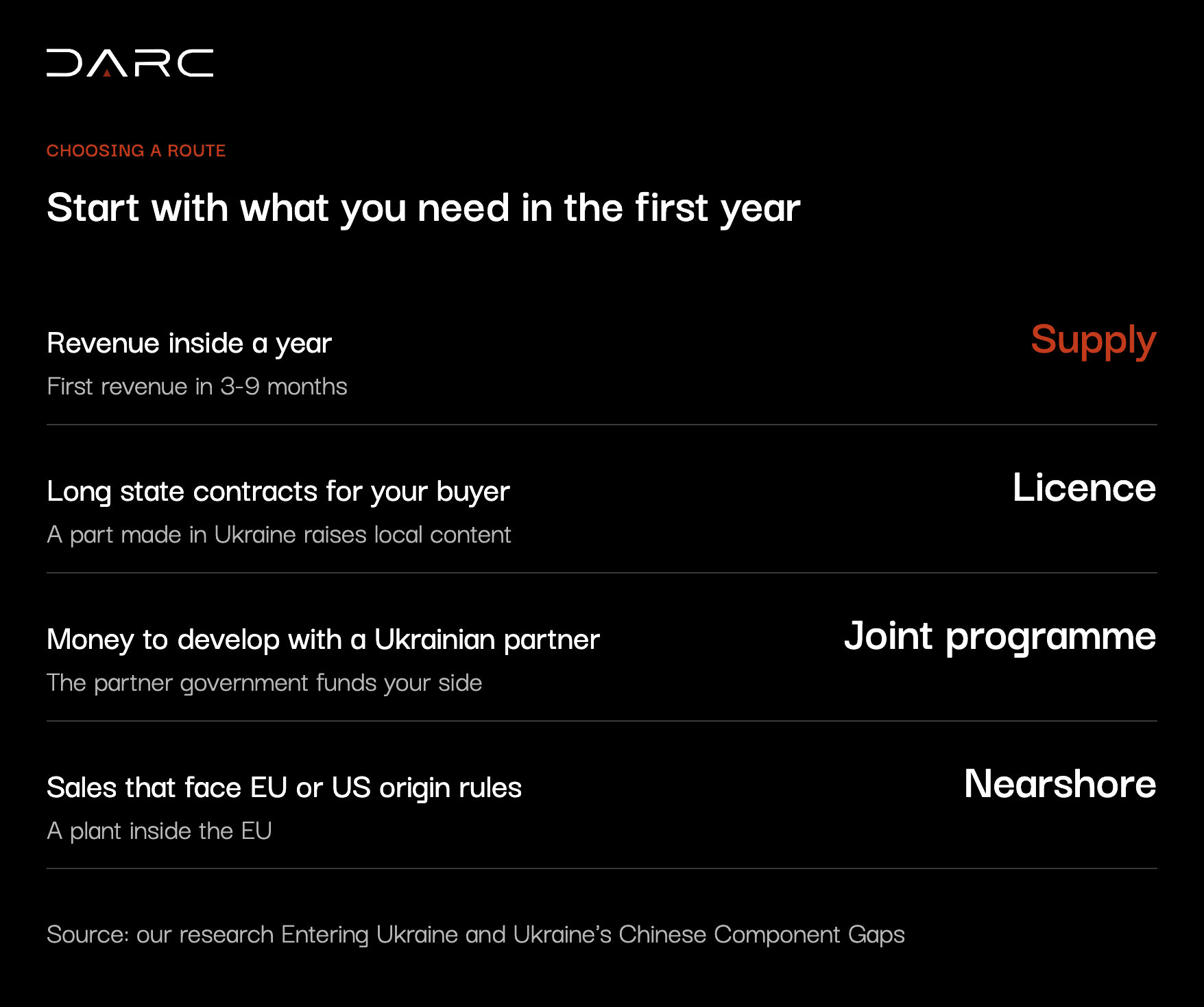
Start with the result you need in the first year.
Revenue inside a year: supply Ukrainian manufacturers.
Long state contracts for your buyer: license production in Ukraine, which raises local content.
Money to develop with a Ukrainian partner: a joint programme, where the partner government funds your side.
Sales that face EU or US origin rules: a nearshore plant inside the EU.
Whichever route you choose, start in person. Our co-founder Ruslana Safina explained in her video how 3 days and 20+ meetings in Ukraine did more for an American manufacturer than a year of calls.
For the full entry picture, including routes for finished products, read How to Enter the Ukrainian Defence Market in 2026. For real partnership structures, see Case Studies: How Foreign Companies Actually Entered Ukraine. For the parts Ukraine still buys from China, see How to Sell Drone Components to Ukrainian Manufacturers in 2026.
By 4 routes: supply Ukrainian manufacturers, license production to a Ukrainian company, join a joint programme with a Ukrainian partner, or open a nearshore plant. Supply is the fastest, with first revenue in 3 to 9 months on our estimate.
Usually not, if you supply Ukrainian manufacturers. You need one for a joint venture in Ukraine, your own plant, Brave1 grants or Defence City. In joint programmes, you pair with a Ukrainian company instead.
Choose the structure first: a licence, a joint venture in Ukraine or joint production abroad under Build with Ukraine. Then check the partner and agree who holds the technology. Your own production in Ukraine starts at about USD 6 million and takes 12 to 24 months to first revenue, according to Entering Ukraine. It gives no separate figure for licensing alone.
Through BRAVE FRANCE, a EUR 20 million joint grant programme of Brave1 and France's Defence Innovation Agency, with grants of up to EUR 1 million, whose first call was planned for September 2026. Build with Ukraine offers joint production in Europe. Licensed production in Ukraine is a third option.
State programmes set the frame: Brave1 runs the joint grant programmes, and Build with Ukraine covers joint production abroad. Our team at DARC helps manufacturers from NATO and allied countries choose a route, find a Ukrainian partner and check it.
3 to 9 months when you supply Ukrainian manufacturers, according to our research Entering Ukraine. Your own production in Ukraine takes 12 to 24 months to first revenue.
Guides
Ukraine uses 100,000+ thermal cameras a month and makes no sensor dies. Demand, China's licences, non-Chinese prices and how suppliers can sell there.

Guides
Where Ukrainian drone makers still rely on China in 2026: 7 component gaps, China's share in each, who can close them and how Ukrainian makers buy.
Guides
Where to find Ukrainian defence manufacturers, the 7 checks to run before you sign, and how partnerships with Ukrainian companies are set up in 2026.