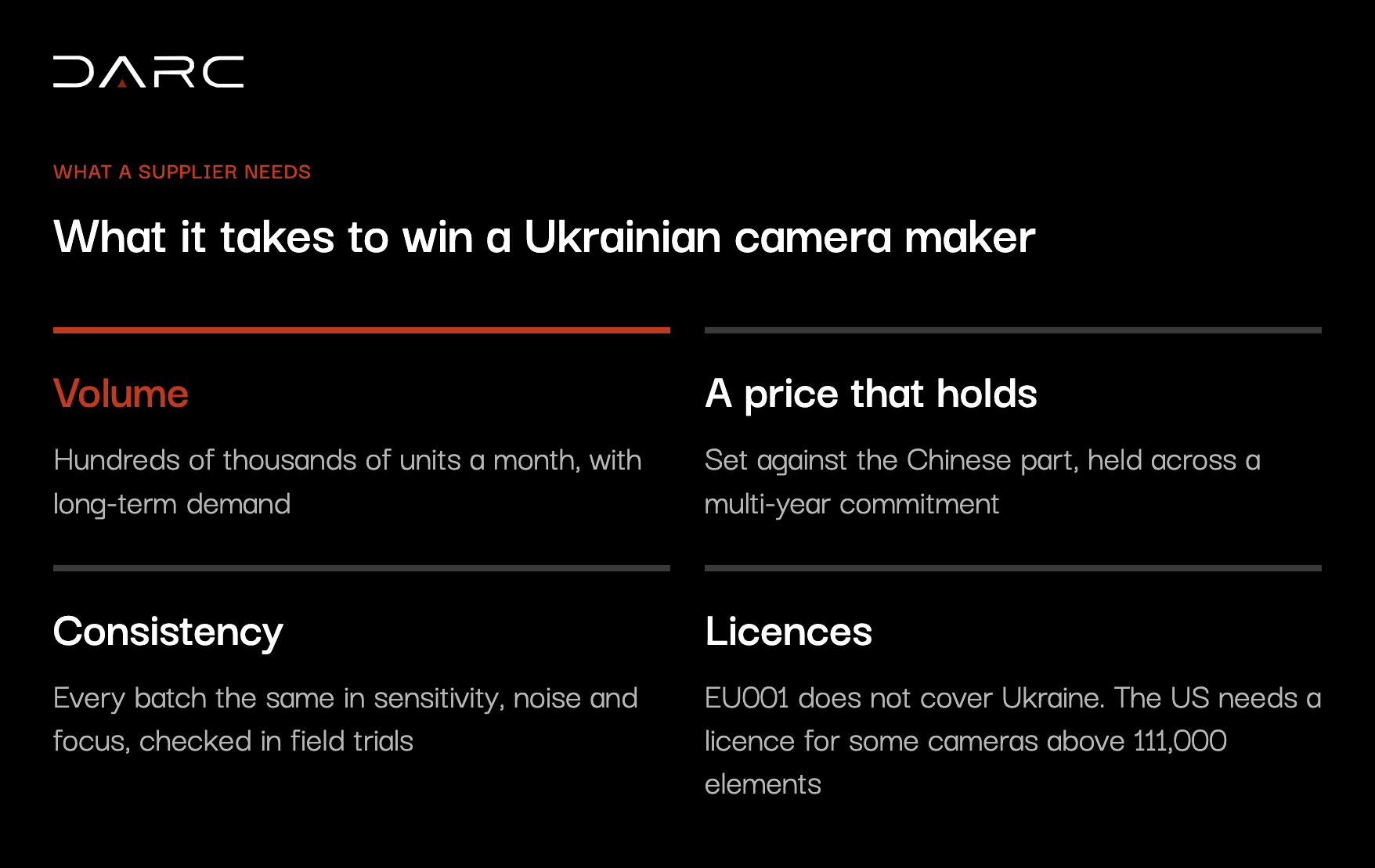
The camera is the most expensive part of a drone, DOU notes, and the sensor inside a thermal camera is a part Ukraine cannot make yet. This article is for makers of thermal sensors, cores, lenses and optics from NATO and allied countries. It covers the size of Ukrainian demand, where China stands, what a non-Chinese option costs and how to start selling to Ukrainian camera and drone makers.
The figures come from our research, Ukraine's Chinese Component Gaps, and the public sources behind it. For all 7 gaps China still holds, start with our guide How to Sell Drone Components to Ukrainian Manufacturers in 2026.

How many thermal sensors does Ukraine need?
At least 1.2 million a year, on our research's count. Andriy Tahanskyi, who runs the camera business at Odd Systems, told DOU in April 2026 that Ukraine uses 100,000 or more thermal cameras every month.
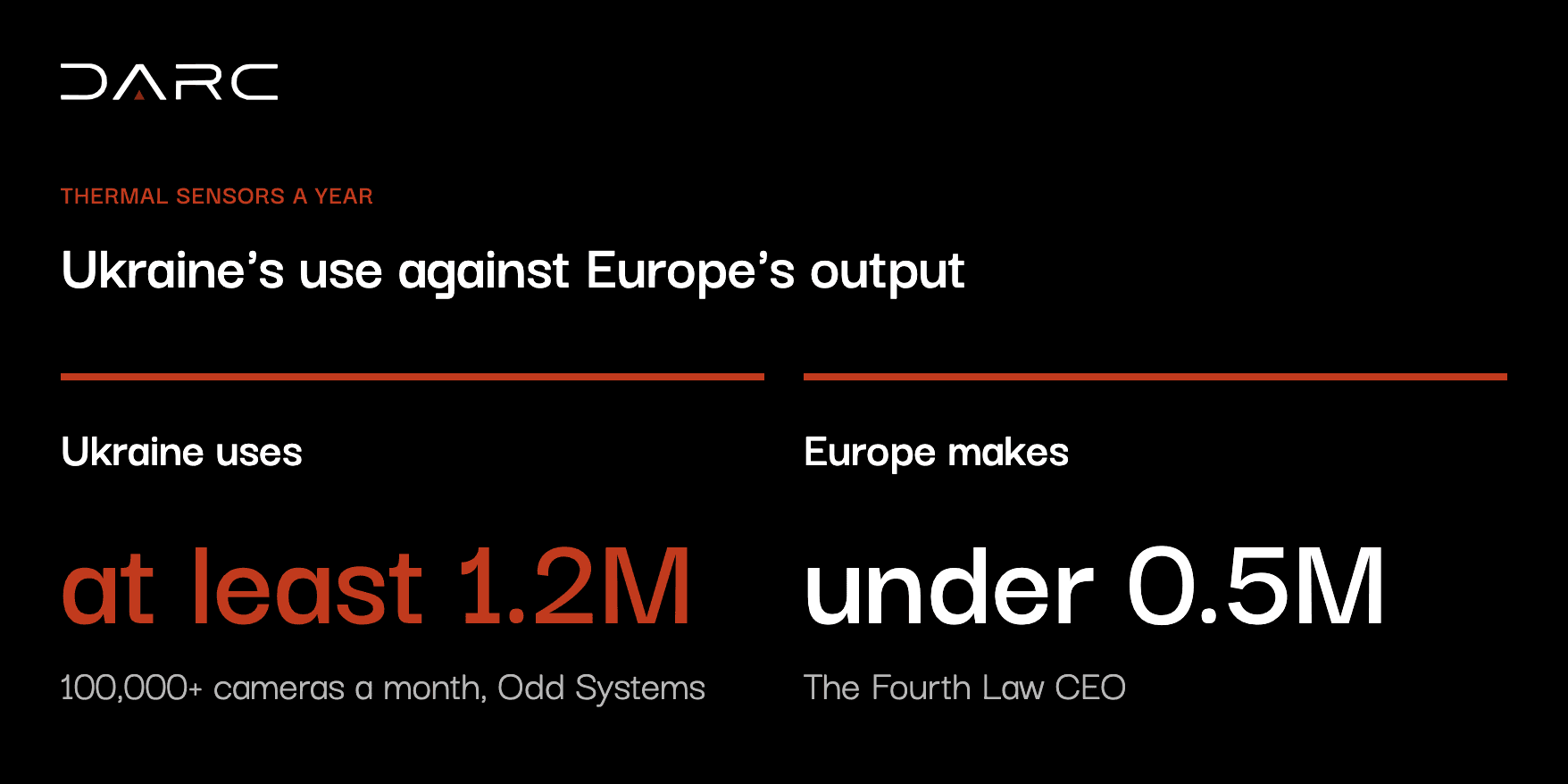
Europe makes fewer than 500,000 of these sensors a year, according to Yaroslav Azhniuk, CEO of The Fourth Law and co-founder of Odd Systems. In his words, Ukraine goes through that amount in about 5 months.
The government sees the same scale. In March 2026, Ukraine's acting minister of digital transformation, Oleksandr Bornyakov, said that every fifth thermal imager in the world ends up on the Ukrainian front.
What does Ukraine make, and what does it import?
Ukrainian companies build the cameras, and the sensor die inside them is imported. Odd Systems says it makes tens of thousands of cameras a month. Oko Camera supplies modules on European sensor arrays and optics to more than 50 drone makers, DOU reported in April. Our research found no sensor die production in Ukraine.
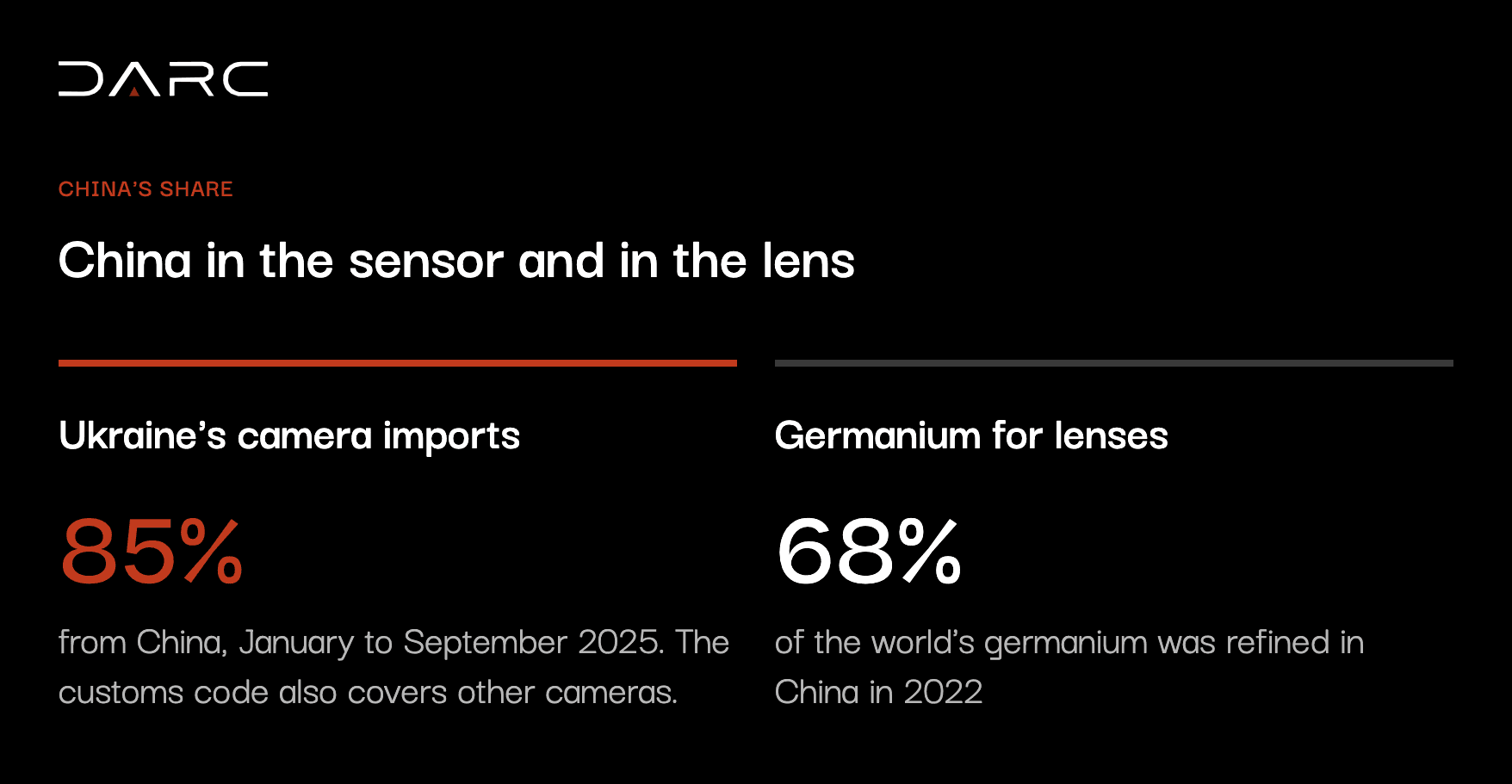
The Fourth Law's CEO says drone camera sensors come from China. Customs data point the same way: Ukraine imported USD 745 million of goods under HS code 8525.89 in January to September 2025, 85% of it from China. That code also covers other cameras, so the share is indicative.
Ukraine's own route to dies is long. Tahanskyi puts a sensor plant at USD 70 to 100 million and at least several years of construction. Brave1's UAV lead says sensor production technology is out of reach for Ukraine in the short and medium term.
Where does China stand?
China holds the volume, and it now licenses exports. Since 1 September 2024, China has required export licences for some thermal imaging equipment and penalises exports of unlisted parts when the exporter knows they are for military use. Our research found no refusal or cut-off aimed at Ukraine. On our reading, the limits for Ukrainian makers today are European volume and global price.
Chinese makers win on scale. One of them, Raytron, states capacity for 3.4 million thermal detectors a year: 2.6 million wafer-level packaged and 800,000 others.
The lens adds a second exposure. Traditional thermal lenses use germanium. China refined 68% of the world's germanium in 2022 and has required licences for germanium exports since August 2023.
What does a non-Chinese option cost?
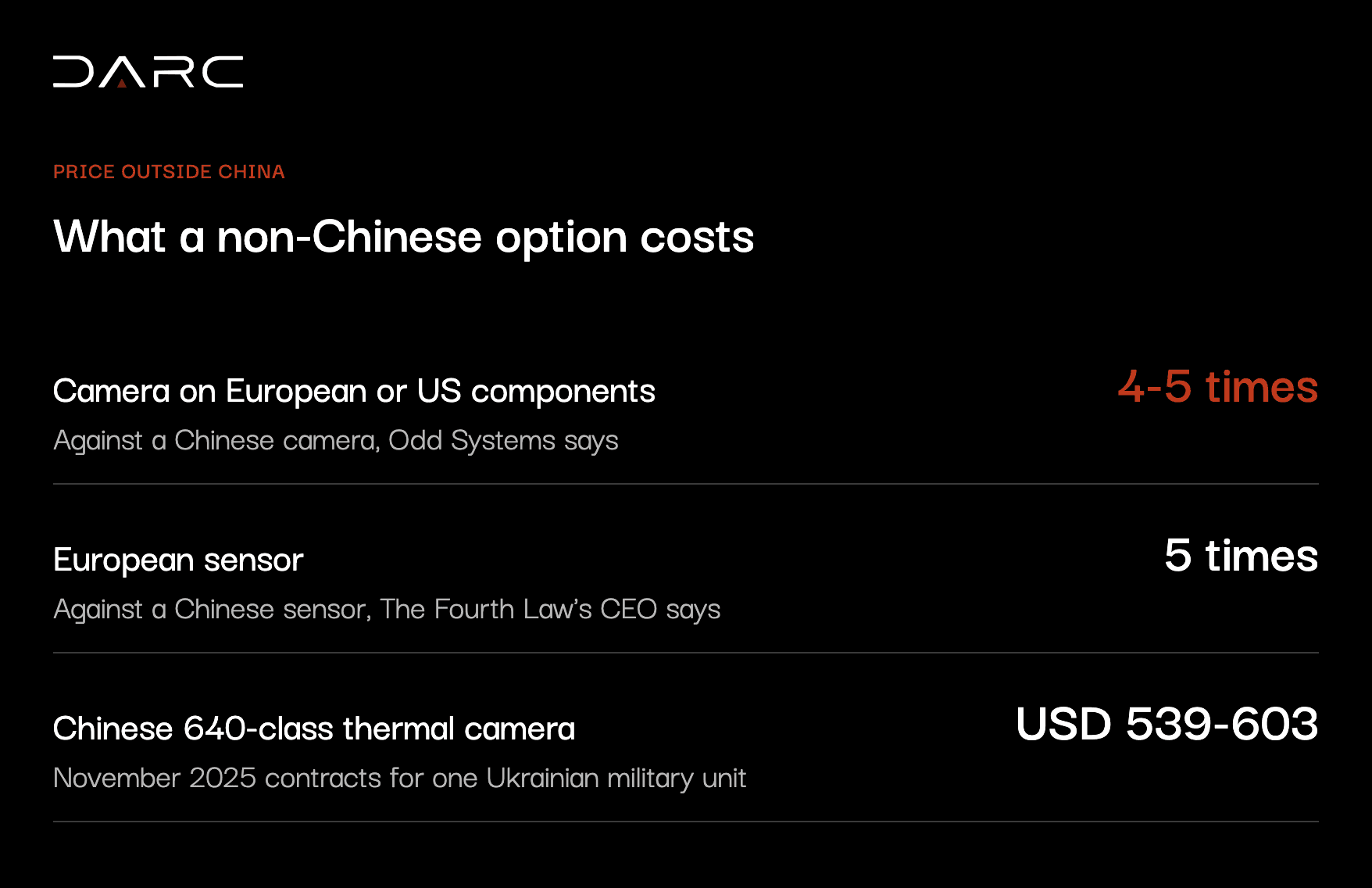
Several times more. Chinese cameras are 4 to 5 times cheaper than solutions on European or US components and are no worse in quality, Tahanskyi says. Azhniuk puts European sensors at 5 times the price of Chinese ones. For scale, a Chinese 640-class thermal camera cost USD 539 to 603 in November 2025 contracts for one Ukrainian military unit, our research found in Prozorro records.
Our research found no public tender that pays more for China-free parts. Origin pays in specific channels. EU procurement financed by SAFE loans caps components from outside the EU, EEA EFTA and Ukraine at 35% of component cost. The Pentagon does not buy drones with cameras made in China. Since Ukraine opened controlled exports under its Drone Deal framework in July 2026, these rules also reach Ukrainian exporters. A Ukrainian maker selling into those channels has a reason to pay for a non-Chinese sensor.
Who is building non-Chinese capacity?
Lynred, Exosens, and The Fourth Law with Odd Systems are adding capacity. The others already make non-Chinese sensors or lenses. All figures below are company statements and plans, and output can be lower.
Lynred, France, says its new EUR 100 million campus brings its capacity to 1 million bolometers. It says its ATI640 thermal cores are ramping up for large-scale drone production.
Exosens, France, plans to triple its drone and counter-drone thermal camera capacity in 2026 and reports a EUR 140 million financing facility from the European Investment Bank.
Obsidian Sensors, US, says it makes thermal sensors on display glass with a high-throughput packaging process, and lists drones among its applications. It publishes no capacity figure.
The Fourth Law and Odd Systems, Ukraine, announced Project Foundation in October 2026: sensor plants in Europe and the US, with first sensors expected in 2027.
LightPath Technologies, US, makes lenses from chalcogenide glass, which it markets as a germanium alternative. In 2024 it stated US capacity of 4 million moulded lenses a year.
Our research found no public supply contract between a Ukrainian camera maker and a non-Chinese die maker. That is the opening for a new supplier.