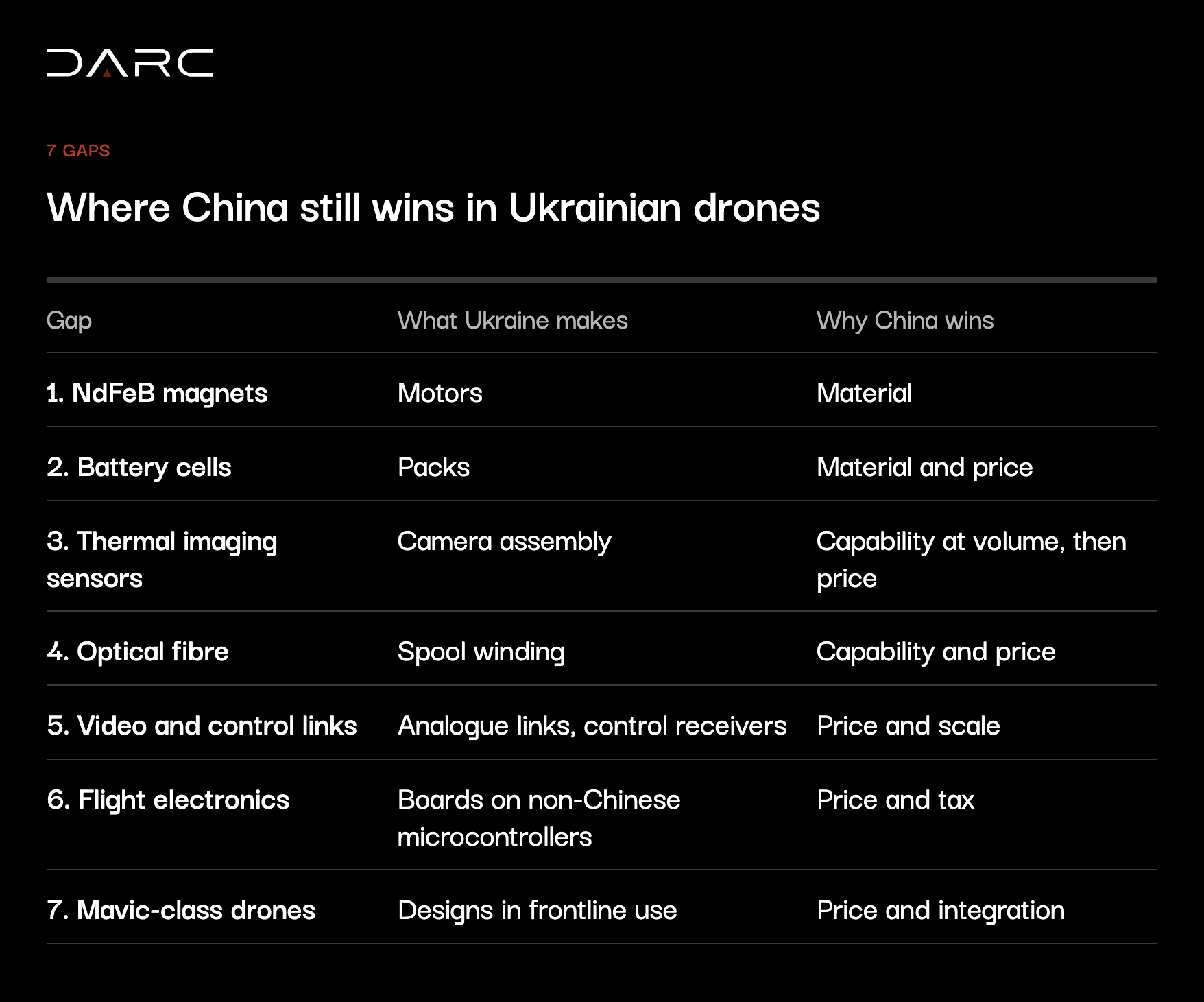
Gap 4: Optical fibre for fibre-optic drones
What Ukraine makes. Fibre-optic drones and their spools: 374,000 fibre-optic drones were delivered under Defence Ministry contracts in 2025. No preform production or fibre drawing was found in Ukraine.
Where China wins. On capacity at the preform and drawing stages. China supplied 91.8% of Ukraine's optical fibre imports in January to September 2025, and makes more than 60% of the world's optical fibre.
Who could close it. Ukraine's 3DTech said in September 2026 that it had begun using fibre from an unnamed European maker, under a limited quota. Corning and Furukawa Electric plan new capacity; neither was found supplying Ukrainian drone makers. Vyriy puts a new fibre plant at about USD 60 million and at least 2 years.
What a supplier needs to know. Supply is tight worldwide: G.652.D fibre prices rose 75% in January 2026, driven mainly by AI data centres. Chinese fibre reached USD 30 per km by the end of March 2026; undated prices for US, South Korean, Japanese and Italian fibre run up to USD 50.

Gap 5: Video and control links
What Ukraine makes. 50-70% of its drones' communication and control parts, but almost no digital video transmitters or receivers, IRON Cluster and the Snake Island Institute found. FT Systems lists analogue transmitters from 1.2 to 8.5 GHz, and Wild Hornets says its digital link is in mass production.
Where China wins. In the chips. All 46 LR1121 receiver designs in the ExpressLRS hardware list run on the ESP32 family from Shanghai-based Espressif.
Who could close it. Doodle Labs (US and Singapore) says its Helix Mesh Rider radio carries video with command and control. Croatia's Orqa makes video transmission systems and says it is building an underground component plant in Ukraine with General Cherry.
What a supplier needs to know. In analogue links, Ukrainian list prices are close to Chinese ones: FT Systems' 4 W transmitter lists at USD 92, against USD 99 for a 5 W Foxeer model, with different specifications. The open space is digital video. No Ukrainian or non-Chinese digital transmitter price was found; DJI's O4 Air Unit Pro lists at USD 229.

Gap 6: Flight electronics
What Ukraine makes. Flight controllers and ESCs on non-Chinese microcontrollers. F-Drones went from an all-Chinese supply chain in 2023 to its own controllers and ESCs by 2025. No named Ukrainian maker of bare circuit boards was found.
Where China wins. On price in finished stacks, and in discretes, passives and packaging. China makes over half of the world's circuit boards, and ST has expanded STM32 production in China, so a non-Chinese microcontroller can be Chinese-made. Since September 2024 China has restricted drone-component exports to Ukraine and russia.
Who could close it. Germany's Donaustahl reports six-figure flight controller output. Orqa and General Cherry plan their Ukrainian plant to start with flight stacks. Auterion produces its Skynode autonomy hardware in Texas and Kyiv.
What a supplier needs to know. Price decides. StingBee lists a Ukrainian-made controller on an STM32H743 chip at UAH 2,600 (about USD 58); US company ARK Electronics lists a board on the same chip at USD 194.99. No grant call was found for discretes, passives or circuit boards.
Gap 7: Mavic-class drones
What Ukraine makes. By the end of May 2025, 10 of 16 Ukrainian designs in the class were codified, and all 10 were in frontline use, Deputy Minister Anna Hvozdiar said.
Where China wins. On price and integration of the finished platform. Two state buyers had contracted at least 10,450 DJI Mavic 3E and 3T by October 2024. No Ukrainian replacement was found for the reconnaissance Matrice or the Autel EVO Max 4T.
Who could close it. Quantum Frontline Industries, a joint venture of Quantum Systems and Ukraine's Frontline, plans at least 10,000 Zoom and Linza drones in Germany in 2026 for Ukraine. Netherlands-based Tulip Tech says its battery pack roughly doubled Mavic 3T and Matrice 4T flight time in some configurations, citing Ukrainian military data.
What a supplier needs to know. For a component maker, the opening sits inside Ukrainian designs: Frontline Robotics says 15% of its parts come from China. A US clearance says little about part origin: Blue UAS vetting excludes motors, batteries and speed controllers.
Beyond the 7 gaps: small jet engines
The Griffen interceptor in Ukrainian service flies on Chinese engines. PBS, one of a few European suppliers, says its capacity is at its limit. In July 2026, PBS and Ukraine's Airlogix signed a memorandum on licensed engine production in Ukraine, starting with assembly.
How do Ukrainian drone manufacturers buy components?
Directly: the Ukrainian manufacturer is the customer, and the supplier usually needs no Ukrainian company. Our earlier research, Entering Ukraine, puts first revenue on this route at 3 to 9 months.
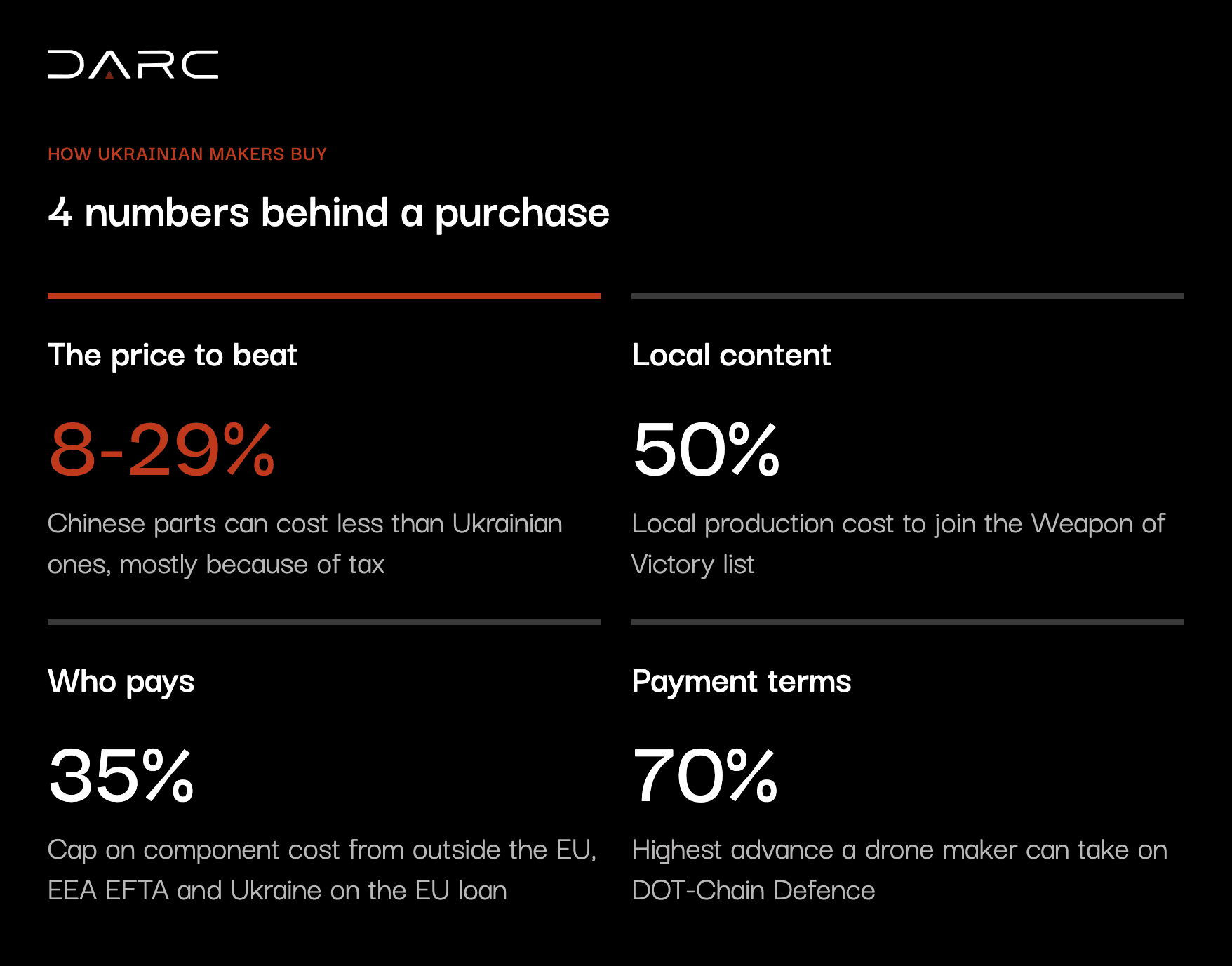
The price to beat. Imported drone parts have been free of VAT and import duty since June 2023, while Ukrainian component makers pay both on imported raw materials. Chinese parts can cost 8-29% less than Ukrainian ones, mostly because of tax, according to IRON Cluster and Technological Forces of Ukraine.
Local content. Drone makers above 50% domestic component value qualify for guaranteed state contracts of 3, 5 or 10 years under the Weapons of Victory resolution. On our reading, a part from Germany or Taiwan counts against that threshold just as a Chinese one does.
Who pays. EUR 60 billion of the EU's EUR 90 billion Ukraine Support Loan goes to defence, with payments since June 2026. Components from outside the EU, EEA EFTA and Ukraine can make up at most 35% of component cost. The Commission approved exceptions in April and July 2026, and the Financial Times reported that the first drone tranche waived the cap for engines, flight controllers and batteries. No public tender was found paying more for China-free parts.
Payment terms. Since 28 April 2026, drone makers can take advances of up to 70% on DOT-Chain Defence, the state online marketplace. Agree who funds stock before the first order.
Trust. In a poll of 30 Ukrainian manufacturers, 76.7% said they would drop Chinese suppliers for a competitive alternative. In our conversations with Ukrainian makers, the wish to switch comes up almost every time. What holds them back is doubt that a partner can match the price, quality and volume, so plan for samples and a test batch.
→ Deep dive: coming in November
For licensed production, joint programmes and nearshore plants, read How to Enter the Ukrainian Defence Market in 2026. To check the manufacturer you will supply, read How to Find and Validate a Ukrainian Defence Manufacturing Partner.
Frequently asked questions
Can a foreign company sell drone components to Ukrainian manufacturers?
Yes. A supplier from NATO and allied countries can sell directly to Ukrainian drone makers, usually without its own Ukrainian company. Listed dual-use items shipped from the EU need an export licence.
What drone components does Ukraine still import from China?
China supplied 38% of the drone components Ukraine imported in the first half of 2025, according to the Ukrainian Council of Defense Industry and the Snake Island Institute. In January to September 2025, it supplied 95.7% of Ukraine's permanent magnet imports, 91.8% of its optical fibre imports and 72.9% of its lithium-ion battery imports.
What does Ukraine's defence industry need from foreign suppliers?
Mostly the materials and sub-components it cannot yet make: NdFeB magnets, battery cells, thermal sensor dies, optical fibre, and the chips inside radios and flight controllers.
Are Ukrainian drone makers ready to switch from Chinese suppliers?
Most say they are. In a poll of 30 Ukrainian manufacturers, 76.7% said they would drop Chinese suppliers for a competitive alternative. What holds them back is doubt that a partner can match the price, quality and volume.
How much more does a non-Chinese drone component cost?
It depends on the part: a median 31% more per Ah for Samsung-cell battery packs against Lishen-cell packs, 4-5 times the Chinese price for thermal cameras on European or US components, and up to USD 50 per km for non-Chinese optical fibre against USD 30.