Ukraine has about USD 19 billion of proven defence production capacity that its own budget does not fund. That capacity is open to partner funding and export.
Start with a partner: buyers outside drones, most money channels and spare capacity sit with Ukrainian companies.
Choose the structure first: supply, co-production, a joint venture or equity.
Find partners through state marketplaces, Brave1 programmes and partner-government production programmes.
Run 7 checks before you sign. Start with ownership, delivery history and engineering depth.
For a foreign company, the first Ukrainian customer is often a Ukrainian manufacturer. Here is where to find a partner and the 7 checks our team runs.
In 2025, Ukraine's defence industry could produce about USD 35 billion. Funded demand was about USD 16 billion, which leaves about USD 19 billion of proven capacity open to partner funding and export.
Our team at DARC brings manufacturers from NATO and allied countries into Ukraine. We check the Ukrainian partner before every introduction.
Why start with a Ukrainian partner?
Because a Ukrainian partner gives a foreign company access to buyers, money and production capacity in Ukraine.
Buyers. Outside drones, a foreign supplier often sells to a Ukrainian manufacturer. About 500 Ukrainian companies build drones, and they buy the parts they cannot make.
Money. Most money channels pay a Ukrainian company first. The state budget usually pays a foreign company through a Ukrainian one. The section on who pays below lists all 5 channels.
Capacity. The spare production capacity sits in Ukrainian companies. A partner can offer a working line, and a new plant can take years.
What kind of partnership do you need?
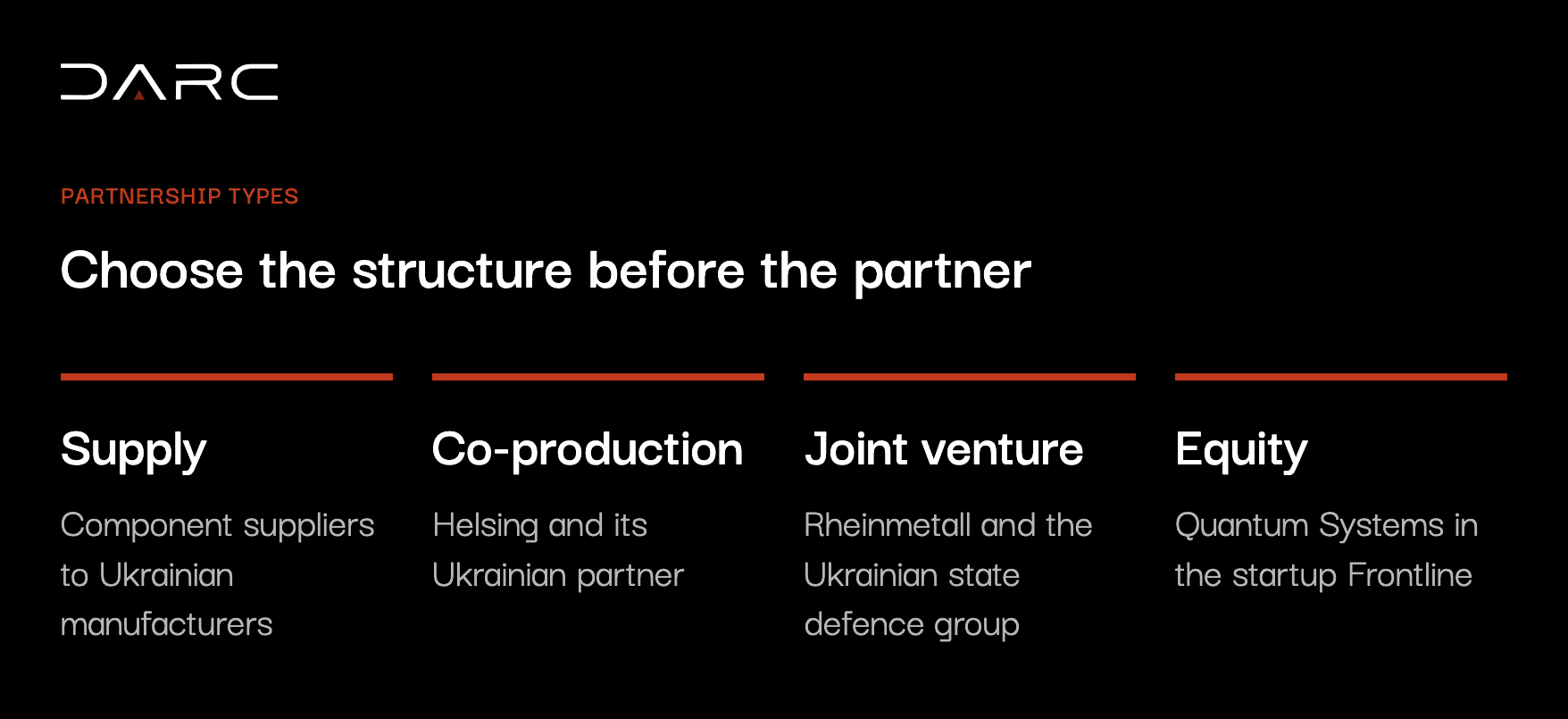
Choose the structure before the partner. Each one needs a different commitment from you.
Structure
What you commit
What you get
Example from our research
Supply components
A product and a delivery contract, usually no Ukrainian company
Revenue in 3 to 9 months
Component suppliers to Ukrainian manufacturers
Co-production
A contract with a Ukrainian partner
Local production through the partner
Helsing: HF-1 co-production with a Ukrainian partner
Joint venture
Capital, control terms and a Ukrainian company
A local production base and access to local incentives
Rheinmetall: 51 percent joint venture with the Ukrainian state defence group
Equity
Cash
A stake in Ukrainian engineering
Quantum Systems: a stake in the startup Frontline
You can also go without a partner. BAE Systems set up its own Ukrainian company in 2023, ahead of its artillery localisation agreements. Quantum Systems opened its own factory in 2024. The owner then carries all the capital, staff and physical risk. For the budget of each route, read How to Enter the Ukrainian Defence Market in 2026.
Recent steps, as of September 2026
These steps are not in our research. Most are memoranda, so check the stage of each.
In September 2026, Germany's Wingcopter said Ukraine could receive its Wingcopter 262 reconnaissance drone. Wingcopter and the Ukrainian drone maker TAF Industries signed a memorandum to set up a joint venture that makes drones.
On 3 August 2026, France's Alta Ares and the Ukrainian interceptor maker General Cherry signed a memorandum of understanding. It covers Alta Ares software in the Bullet interceptor. No delivery timeline was announced.
On 24 August 2026, the UK government said it had cleared MBDA to share classified data on the UK parts of the SCALP missile. The aim is for Ukraine and France to set up assembly lines in Ukraine.
Where do you find Ukrainian defence manufacturers?
There is no single directory. Use these sources together.
State marketplaces. DOT-Chain Defence is the state online marketplace where units order. As of September 2026, it lists more than 1,200 products from about 300 Ukrainian manufacturers. Brave1 Market works the same way. A listing shows that units can order from the company.
Brave1 programmes.According to KSE Institute, Brave1 gave more than USD 60 million in grants to over 600 companies in 2025.
Partner-government programmes. Under the Danish model, partner states pay for production inside Ukrainian companies. Under Build with Ukraine, they fund Ukrainian production lines abroad. The foreign partner brings money and capacity. The Ukrainian partner brings integration know-how.
Not sure which structure you need?
Tell us what you make. We will tell you which of the 4 fits your product.
A listing shows that units can order from a company. A partnership needs more. Our team runs these checks before we introduce a foreign company to a Ukrainian one. The last check continues into the draft agreement.
What to check
Why it matters
Where to look
I. Ownership
Ownership must be disclosed, with no links to russia. The same test applies to Defence City and export permits
State registry, sanctions lists, court records
II. Delivery history
Announced capacity often runs ahead of built capacity. Compare the volumes a company claims with the revenue it reports
Strong partners improve the product. Ask which foreign designs their engineers have reworked
Own design or assembly, named engineers, past redesigns
IV. Finances
If one manufacturer is your only customer, its balance sheet is your risk
Registry financial statements, order book, grants
V. Who signs
The person at the table may have no right to sign. Check this before terms are agreed
State registry: directors and signing rights
VI. Export readiness
Export needs proven serial production, a clean tax record and clear ownership
Tax record, export history
VII. IP
Designs you share sit with a partner in a country at war. Later, its products may compete with yours abroad
Draft agreement: who owns improvements and who can export
Who pays inside a partnership?
Start with one question: who funds production before the first payment? Then check which money channels can reach each side.
5 money channels reach Ukrainian defence. They pay different recipients.
The state budget usually pays a foreign company through a Ukrainian company.
Partner-state money under the Danish model goes to Ukrainian manufacturers. A foreign company reaches it as a joint venture partner.
EU loan facilities pay foreign companies directly, and the customer is a partner government. In September 2026, the Commission President said unused SAFE money will fund a new programme of joint projects with Ukrainian companies.
Brave1 grants and state loans go to Ukrainian companies only. In a joint project, the Ukrainian partner applies. By late July 2026, Ukrainian defence companies had taken 167 state-subsidised loans worth more than UAH 10 billion.
Private capital buys equity in Ukrainian startups.
How do you set up a joint venture?
I. Decide what it must return. Revenue, a production base and an export base need different structures.
II. Set up the Ukrainian company early. Defence City and most domestic contracts need a company registered in Ukraine. A company registered in 2026 realistically qualifies for Defence City in 2027.
III. Agree control and reinvestment. Defence City's profit tax exemption applies to profit reinvested in Ukraine's defence sector, with no dividends.
IV. Plan extra time for production. Site selection and permits set the timeline.
V. Line up the money. Partner-state programmes fund production. The EU's SAFE loans let member states buy with Ukraine, for Ukraine and in Ukraine.
Not every partnership needs a joint venture. In June 2026, the Ukrainian ground-robot maker UUT signed an industrial partnership with Haulotte, a French manufacturer. UUT keeps the design, and Haulotte brings production capacity and service. MergeWave Capital, which powers DARC, represented UUT. It took about 4 months from the first meeting to the agreement.
For more cases, read Case Studies: How Foreign Companies Actually Entered Ukraine.
Frequently asked questions
Do I need a Ukrainian company to partner with a Ukrainian manufacturer?
Not to supply components or to co-produce through a partner. You need one for Defence City and, in practice, for domestic contracts.
How long does a joint venture take?
A new plant can take years. Site selection and permits are often the bottleneck. Our case studies show the dates.
Who helps foreign defence companies create joint ventures in Ukraine?
Partner-state programmes fund production. Brave1 gives grants to Ukrainian companies, and its Test in Ukraine programme accepts foreign companies. DARC, powered by MergeWave Capital, finds and checks the Ukrainian partner and helps set up the deal.
Is it safe to share IP with a Ukrainian partner?
It carries a real risk, so plan for it. Agree who owns improvements and who can export them before the first batch.
UKRAINEMARKETENTRYCALL
Tell us what you build. We will map the route, the buyer and the first step.