


Guides
Thermal Imaging Sensors for Ukraine in 2026: Demand, the Supply Gap and Who Can Close It
Ukraine uses 100,000+ thermal cameras a month and makes no sensor dies. Demand, China's licences, non-Chinese prices and how suppliers can sell there.

China-free origin pays mainly where EU or US money sets the rules. Ukraine's own tenders and grants reward price, volume and local content.
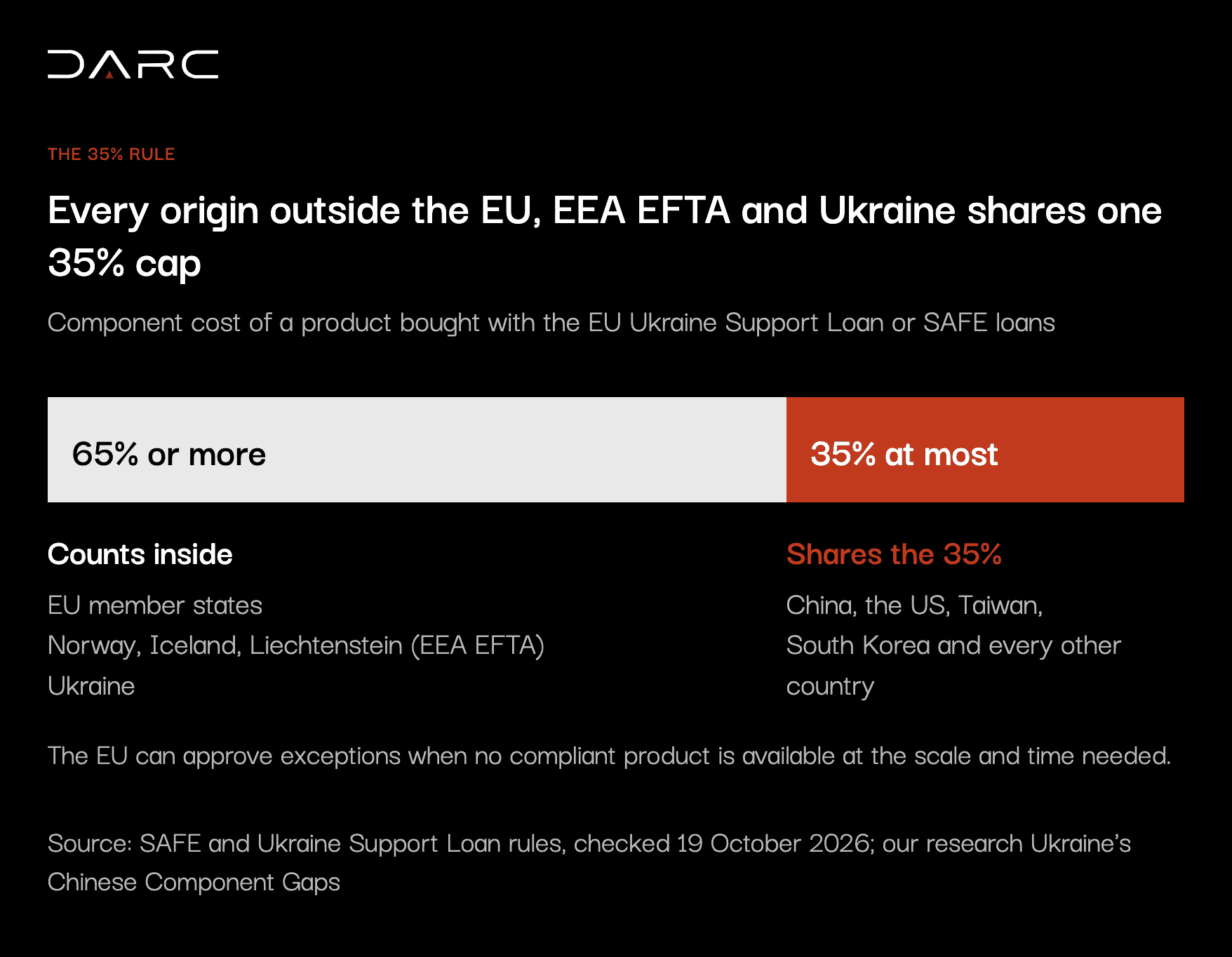
EUR 60 billion of the EU's EUR 90 billion Ukraine Support Loan goes to defence, with payments since June 2026. Components from outside the EU, EEA EFTA and Ukraine can make up at most 35% of component cost.
The 35% cap treats every outside origin the same way. A part from the US, Taiwan or South Korea takes the same space as a Chinese one.
Brave1 pays Ukrainian component makers up to UAH 8 million per grant. Our research found no public call for cells, chips, thermal sensor dies or optical fibre. Magnet manufacturing has one, in Brave1’s EU-funded grant programme.
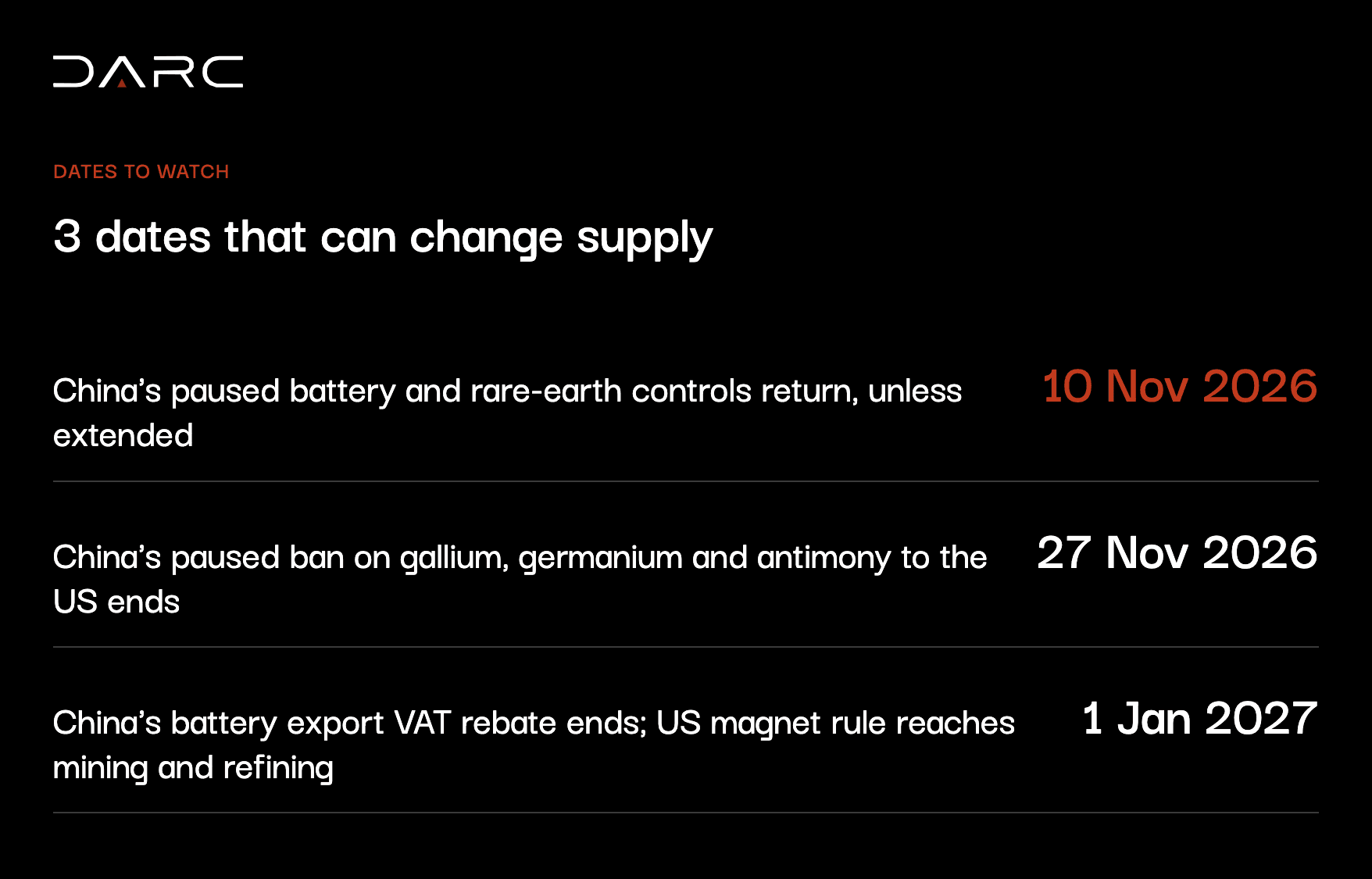
3 dates can change supply: 10 November 2026, which China has signalled may move to 10 January 2027, 27 November 2026 and 1 January 2027.
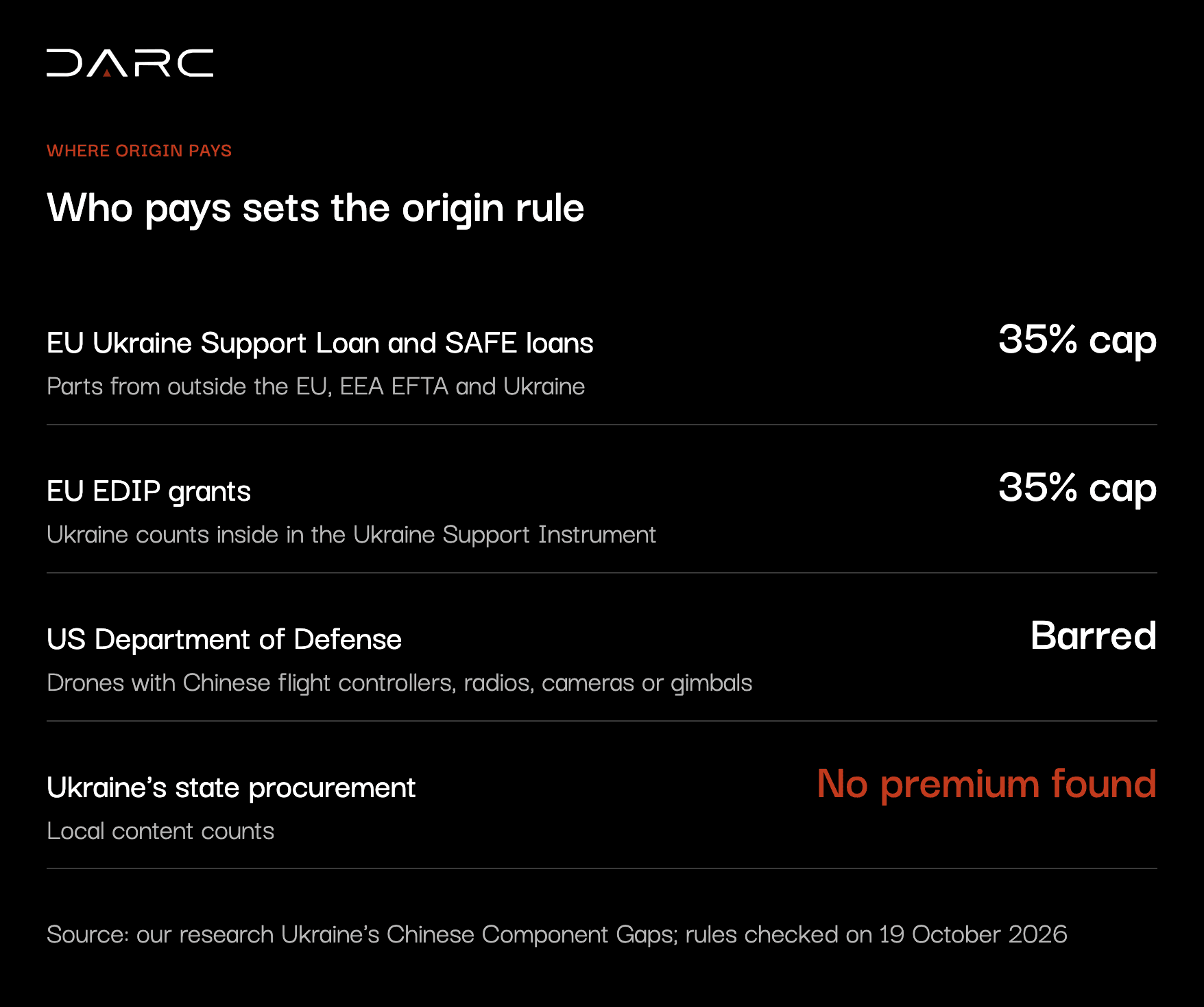
China-free parts get paid for in Ukraine where EU or US money sets origin rules. The EU's Ukraine Support Loan, its SAFE defence loans and its EDIP grants cap outside components at 35% of component cost. The US Department of Defense bars drones with Chinese-made flight controllers, radios, cameras and gimbals. Ukraine's own tenders and grants pay for price, volume and local content.
This guide draws on our research of Ukraine's Chinese Component Gaps, built by our research team from public sources up to 14 September 2026. We checked the rules and dates again on 19 October 2026. For the 7 component gaps China still holds, start with our guide How to Sell Drone Components to Ukrainian Manufacturers in 2026.
In the channels where EU loans, EU grants or the US Department of Defense pay. Each channel has its own origin rule.
Channel | Origin rule | What it means for a China-free part |
EU Ukraine Support Loan | At most 35% of component cost from outside the EU, EEA EFTA and Ukraine, with exceptions | Parts made in the EU, EEA EFTA or Ukraine sit outside the cap |
EU SAFE loans | The same 35% cap | The same as the loan |
EU EDIP grants | At most 35% from outside the EU and associated countries | Ukraine counts inside only in the Ukraine Support Instrument |
US Department of Defense | No drones with flight controllers, radios, data links, cameras or gimbals made in China | A Chinese part in these classes rules the drone out |
Ukraine's state procurement | No origin premium found; local content counts | Every imported part lowers local content |
Brave1 grants | Own grants: companies registered in Ukraine; partner-funded calls can pay foreign companies | One call for magnet manufacturing; none found for cells, chips or fibre |
Our research found no public tender or contract that pays more for China-free parts. Origin pays through the buyer's source of money. When the EU loan pays for a Ukrainian drone, the drone has to meet the 35% cap, unless an exception applies.
EUR 60 billion of the EU's EUR 90 billion Ukraine Support Loan goes to defence, and payments started in June 2026. The first defence payment, EUR 3.9 billion on 30 June, went to drone procurement, according to the European Commission.
The loan applies the same component rule as SAFE, the EU's defence loan programme for its member states. Components from outside the EU, EEA EFTA countries (Norway, Iceland, Liechtenstein) and Ukraine can make up at most 35% of estimated component cost. Parts made in Ukraine count on the same side as EU parts.
Rules on who controls the supplier apply as well. An EU-based company controlled from outside can still qualify after an investment screening or with security guarantees.
The EU allows exceptions when no compliant product is available at the scale and time needed. The Commission approved such exceptions for Ukraine’s first, drone-focused product schedule on 1 April 2026 and for a second schedule on 16 July 2026. Both schedules are classified. On 11 September 2026, it approved 5 more: 3 for Ukrainian-made drones and components above cost limits and 2 for US-made equipment such as PAC-3 missiles. The Financial Times reported in July 2026 that the EUR 5.9 billion first drone tranche lets Ukraine buy certain Chinese components. Its sources said these parts are not available in sufficient quantities in Europe.
For a supplier from outside these countries, the 35% is the space your part competes for. A US, Taiwanese or South Korean part counts there just as a Chinese one does. A part made in the EU, EEA EFTA or Ukraine stays outside the cap.
Yes, in its Ukraine Support Instrument. EDIP, the European Defence Industry Programme, provides EUR 1.5 billion in grants for 2025-2027, the EU Council said at final approval. Components from outside the EU and associated countries can make up at most 35% of the end product's component cost. Ukraine counts on the inside for the Ukraine Support Instrument, which has EUR 300 million.
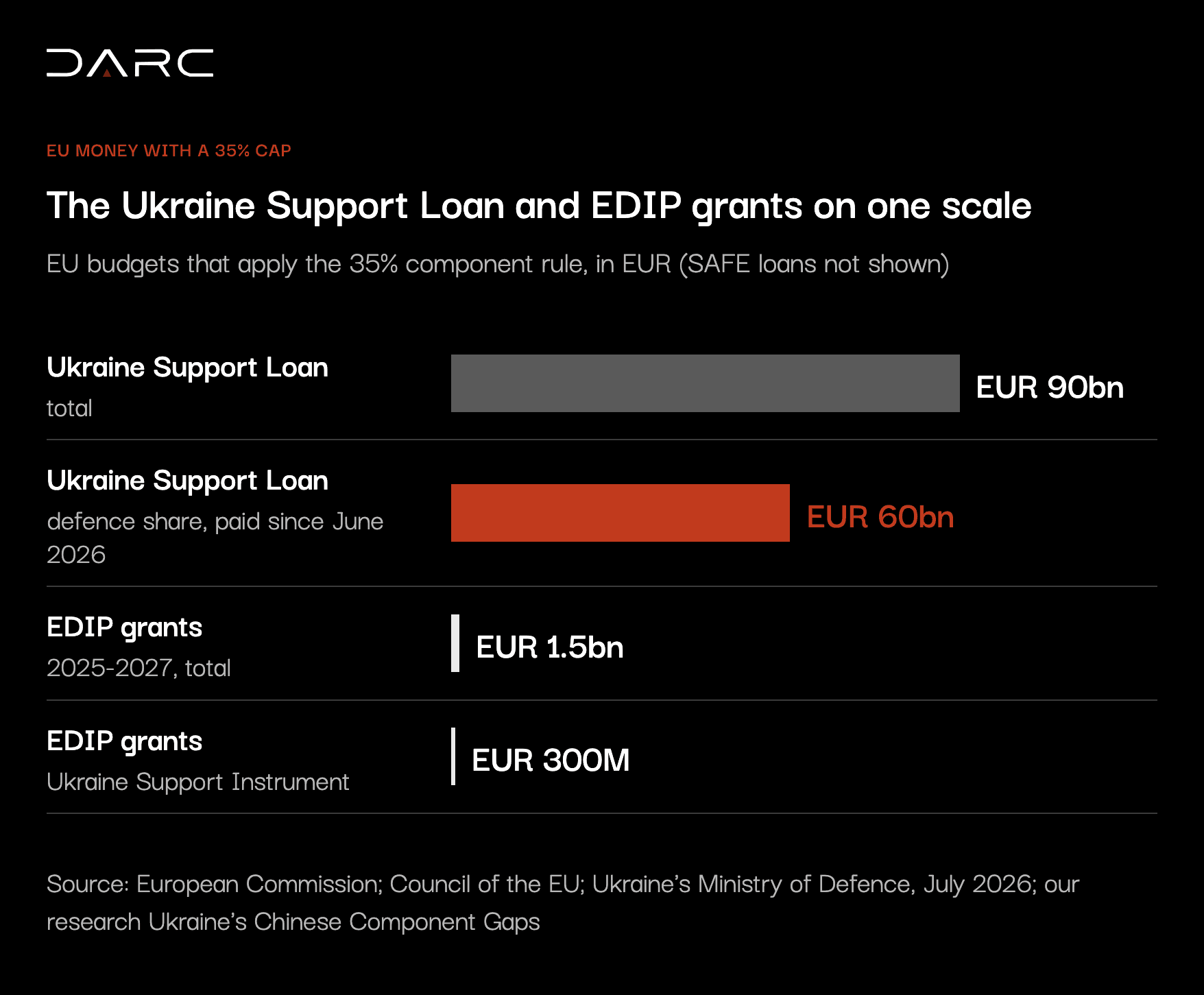
Of that amount, EUR 260 million goes to manufacturing capacity and EUR 35.3 million to innovation under BraveTech EU. Ukraine's Ministry of Defence gave these figures in July 2026. The next step it named is grants open to both Ukrainian and EU companies.
For an EU company, a part made with a Ukrainian partner counts inside the 35% in these projects. It counts the same way in the Ukraine Support Loan and in SAFE. In Ukraine, it also raises the buyer's local content.
Send us a message with what you make, and we will send you the names of Ukrainian makers that fit.
In Ukraine's own procurement, where the price to beat is the Chinese part. Imported drone parts have been free of VAT and import duty since June 2023. Ukrainian component makers pay both on imported raw materials. Chinese parts can cost 8-29% less than Ukrainian ones, mostly because of tax, according to IRON Cluster and Technological Forces of Ukraine.
Local content rewards production in Ukraine, whatever the country of import. A weapon needs at least 50% local production cost to join Ukraine's Weapon of Victory list. Makers on the list can get state contracts of 3 to 10 years. A part from Germany or Taiwan lowers the local share just as a Chinese one does. A part made in Ukraine under licence raises it.
Payment terms reward speed. Since 28 April 2026, drone makers on DOT-Chain Defence, the state online marketplace, can take advances of up to 70%. The condition is an average delivery time of up to 30 days. Agree who funds stock before the first order.
It depends on the part, and the gap can be large:
Battery cells. Across 8 matched pairs, packs on Samsung SDI cells cost a median 31% more per Ah than packs on Chinese Lishen cells. These are retail prices from 13 September 2026.
Battery materials. Non-Chinese upstream inputs cost 40-50% more, according to Taiwan's DSET institute, Focus Taiwan reported.
Thermal cameras. Chinese cameras are 4-5 times cheaper than those on European or US components, Ukraine's Odd Systems says.
Optical fibre. Chinese fibre reached USD 30 per km by the end of March 2026. Undated prices for US, South Korean, Japanese and Italian fibre run up to USD 50.
These gaps explain why origin rules matter. Where a buyer has to meet the 35% cap or a US rule, a higher price can still win the order. Our co-founder Ruslana Safina explained in her video why a part that costs 50% more for 10% better performance is a hard sell in Ukraine.
Most grants fund finished parts and complete systems. Brave1, Ukraine's state defence tech cluster, launched a component grant programme in December 2025. It pays up to UAH 8 million per grant, about USD 180,000, for projects at combat testing.
Brave1’s own grants go only to companies registered in Ukraine. Since 30 June 2026, Resolution No. 829 also lets Brave1 pay companies registered abroad in partner-funded competitions, using only the partner’s money. In UNITE Brave NATO, Brave1 funds the Ukrainian company and NATO funds the company from a NATO country, with up to EUR 1 million per joint project. Its first call closed to new teams on 3 August 2026.
Brave1’s December 2025 component programme funds motors, propulsion, computing and sensors, communications, cameras and gimbals. Its EU-funded programme, open since 30 June 2026, adds manufacturing technology for N48 or higher NdFeB magnets and for thermal camera lenses. Our research found no public call for battery cells, chips, thermal sensor dies, optical fibre or cell materials, as of 13 September 2026.

Section 848 of the US FY2020 defence law (NDAA) bars the Department of Defense from buying or operating drones made in China. It also bars drones that use flight controllers, radios, data transmission devices, cameras or gimbals made there. The same applies to russia, Iran and North Korea.
From 1 January 2027, the Department's magnet rule goes further. It bars contracts for NdFeB and samarium-cobalt magnet material mined, refined or separated in China, russia, Iran or North Korea, with exceptions.
A US clearance covers only part of the bill of materials: Blue UAS vetting did not treat motors, batteries and speed controllers as critical components, DefenseScoop reported in November 2025.
3 dates in the next 3 months can move prices and lead times for parts made in China or from Chinese materials.
Date | What changes | What it touches |
10 November 2026 | China’s suspended October 2025 export controls take effect, unless the pause is extended; China has signalled 10 January 2027 | Battery cells and materials, rare-earth items made outside China |
27 November 2026 | China's suspension of its ban on gallium, germanium and antimony exports to the US ends | US buyers of these metals |
1 January 2027 | China's export VAT rebate on batteries ends; the US magnet rule reaches mining and refining | Chinese battery prices; magnets for US defence |
10 November. In October 2025, China introduced export licence requirements for lithium-ion cells and packs at 300 Wh/kg or above. The rule also covers cathode materials, graphite anode materials and some of the production equipment behind them. A month later, China suspended it until 10 November 2026, with 5 other announcements. One of them covers certain rare-earth items made outside China, with their parts and assemblies. On 28 September 2026, China’s commerce ministry said the trade arrangement with the US behind this pause now runs to 10 January 2027. As of 21 October 2026, we found no formal notice that moves the 10 November date for these controls.
The 18650 and 21700 cells most drone makers use sit at about 200-240 Wh/kg, below that line, according to the CEO of Ukraine’s DP Battery. On our reading, the risk sits upstream. Cathode, precursor and anode materials make up about 70% of a battery’s cost, according to Taiwan’s DSET institute. China's April 2025 licences on 7 rare earths, including dysprosium and terbium, stay in force.
27 November. China’s ban on gallium, germanium and antimony exports to the US was suspended until this date. We found no notice extending it as of 21 October 2026.
1 January 2027. China cut its export VAT rebate on batteries from 9% to 6% in April 2026 and ends it on 1 January 2027. On the same day, the US magnet rule above takes effect.
Find out who pays your buyer. An EU-funded order carries the 35% cap. A Ukrainian state order rewards local content. A grant pays the Ukrainian applicant.
Count your part's origin. Under the 35% cap, a part from the US, Taiwan or South Korea counts like a Chinese one. Production in the EU, EEA EFTA or Ukraine counts inside.
Consider production in Ukraine. A part made in Ukraine under licence raises your buyer's local content and stays inside the EU cap.
Price against tax. The Chinese part enters Ukraine free of VAT and duty. Your quote competes with that price.
Prepare for 10 November. If China's controls return, buyers may ask for non-Chinese materials at short notice. Have prices, volumes and lead times ready.
Plan for samples and a test batch. In our conversations with Ukrainian makers, the wish to switch from Chinese supply comes up almost every time. What holds them back is doubt that a partner can match the price, quality and volume.

For the routes into Ukraine, from direct supply to licensed production, read How to Enter the Ukrainian Defence Market in 2026. For the gaps where Ukrainian makers need parts, read How to Sell Drone Components to Ukrainian Manufacturers in 2026.
In the EU's Ukraine Support Loan and SAFE, parts from outside the EU, EEA EFTA and Ukraine can be at most 35% of component cost. The Commission can approve exceptions when no compliant product is ready at scale or in time.
No premium was found. The EU loan caps all components from outside the EU, EEA EFTA and Ukraine at 35% of component cost. A US or Asian part competes for the same space as a Chinese one.
Yes, in the Ukraine Support Instrument, EDIP's EUR 300 million budget for Ukraine. There, Ukraine counts with the EU and associated countries under the 35% limit.
Brave1’s own grants, up to UAH 8 million per component grant, go to companies registered in Ukraine. Since June 2026, partner-funded Brave1 competitions can also pay foreign companies from the partner’s money. A foreign company can also join a Ukrainian partner’s project or a joint programme such as UNITE Brave NATO.
China's suspended export controls of October 2025 take effect, unless extended. They include licences for high-energy lithium-ion cells and packs, cathode and graphite anode materials, and certain rare-earth items made outside China.
It depends on the part. Packs on Samsung SDI cells cost a median 31% more per Ah than packs on Lishen cells. Chinese thermal cameras are 4-5 times cheaper, Odd Systems says. Non-Chinese optical fibre runs up to USD 50 per km against USD 30.
Guides
Ukraine uses 100,000+ thermal cameras a month and makes no sensor dies. Demand, China's licences, non-Chinese prices and how suppliers can sell there.

Guides
Where Ukrainian drone makers still rely on China in 2026: 7 component gaps, China's share in each, who can close them and how Ukrainian makers buy.
Guides
Where to find Ukrainian defence manufacturers, the 7 checks to run before you sign, and how partnerships with Ukrainian companies are set up in 2026.