


Guides
Thermal Imaging Sensors for Ukraine in 2026: Demand, the Supply Gap and Who Can Close It
Ukraine uses 100,000+ thermal cameras a month and makes no sensor dies. Demand, China's licences, non-Chinese prices and how suppliers can sell there.

China supplied 72.9% of Ukraine's lithium-ion battery imports by value in January to September 2025, down from 95.5% in 2024. The customs code also covers packs and energy storage.
Ukraine builds drone battery packs at home. Our research found no production of cells, cathode or precursor in the country.
China’s licences on cells at 300 Wh/kg or above and on cell materials are suspended until 10 November 2026, a date China has signalled may move to 10 January 2027. Most drone cells sit below 300 Wh/kg, so on our reading the exposure sits in the materials.
Non-Chinese options cost more. Packs on Samsung SDI cells cost a median 31% more per Ah than packs on Lishen cells, and non-Chinese inputs cost 40-50% more.
Ukrainian pack makers can change the cell without changing the pack. A cell or material supplier sells to many pack makers, each ordering its own batch.
Ukraine does not make battery cells yet. It builds drone battery packs at home from imported cells. China supplied 72.9% of its lithium-ion battery imports by value in January to September 2025. This article is for makers of cells and cell materials from NATO and allied countries. It covers where that share comes from and where China holds the material inside the cell. It also covers what a non-Chinese option costs and how to sell to Ukrainian pack makers.
The figures come from our research, Ukraine's Chinese Component Gaps, and the public sources behind it. For all 7 gaps China still holds, start with our guide How to Sell Drone Components to Ukrainian Manufacturers in 2026.
From Ukrainian customs data. Our research took Ukraine’s imports under customs code HS 8507.60, lithium-ion accumulators, a code that covers single cells and assembled batteries and packs alike, as reported to UN Comtrade. In January to September 2025, Ukraine imported USD 832.3 million under this code, and 72.9% of that value came from China.

The code counts cells and finished batteries together, energy storage included. So the share covers more than drones, because customs data do not separate drone cells.
The share is falling. China supplied 95.5% in 2024. Among the customs codes in our research, this is the only one where China's share fell. Vietnam took a visible part: USD 93.0 million in January to September 2025, or 11.2% of the total, almost all of it shipped in May to July. Our research did not find who owns the Vietnamese plants behind those shipments.

Taiwan moved up too. A report by Taiwan's DSET institute, based on Ukrainian customs data, ranks Taiwan as Ukraine's third-largest battery supplier in 2025, the Taipei Times reported. Only China and Vietnam were ahead.
Ukrainian companies build the packs, and the cells inside them are imported. Our research found no cell, cathode or precursor production in Ukraine. Our co-founder Ruslana Safina named battery cells among the drone parts Ukraine still buys abroad in her 1-minute video.
Ukrainian makers cover more than 80% of demand for structural parts and battery modules, IRON Cluster co-founder Yurii Lomikovskyi told Arsenal in December 2025. Even a cell line bought for Ukraine today would most likely run on Chinese raw material, because European material costs about 3 times as much, PAWELL co-founder Petro Yesyp told Platfor.ma in June 2026.
The packs show how open the cell choice is. One Ukrainian pack maker lists the same pack layouts with cells from China's Lishen and EVE, South Korea's Samsung SDI and Taiwan's Molicel. The same maker builds all of its electronic warfare packs on a 60 Ah cell from South Korea's SK Innovation.
Ukraine has one link further upstream. Zavalievsky Graphite made over 19 t of battery-grade graphite from African flake in March 2026 and sold the batch to a European battery company, Euromaidan Press reported.

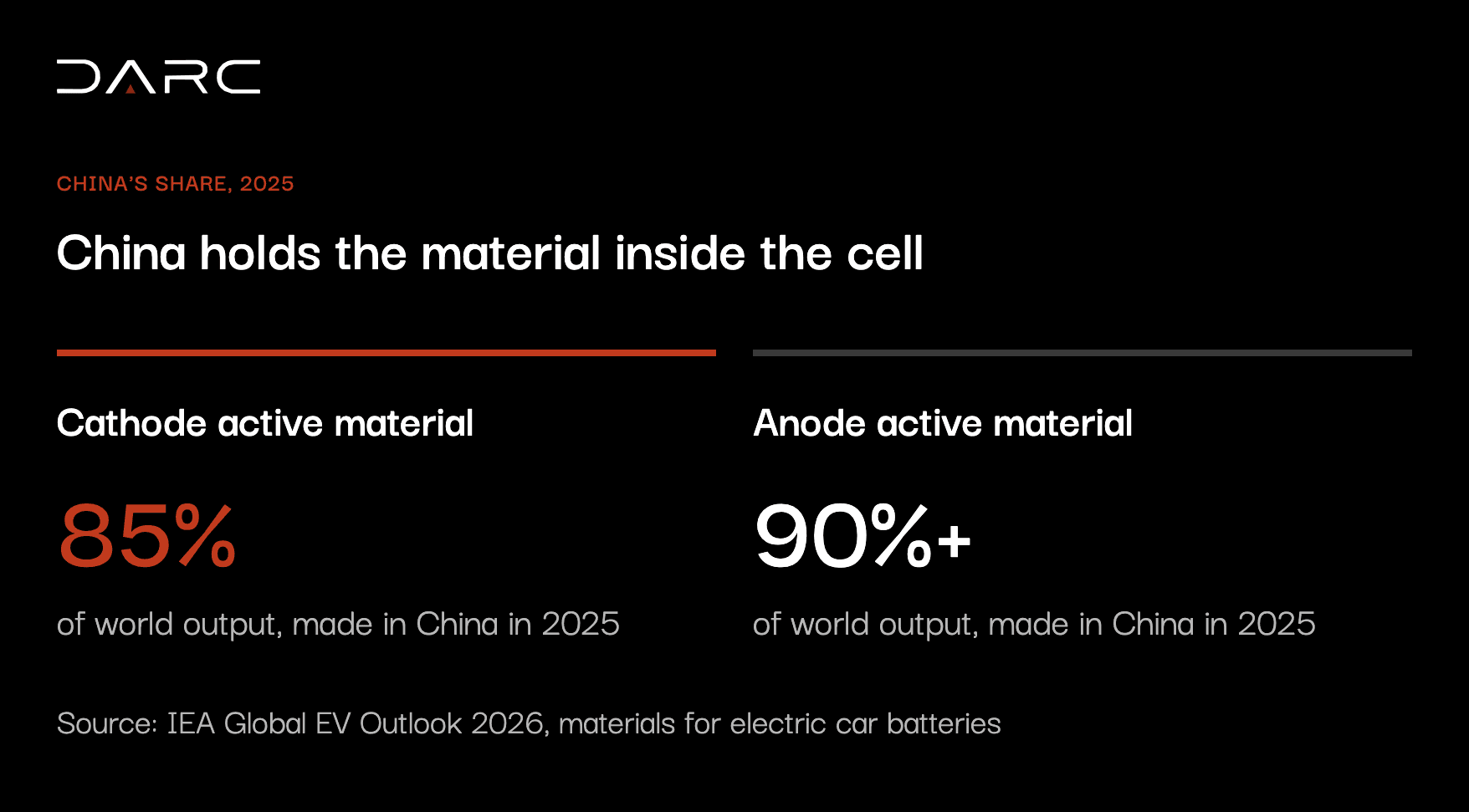
In the cathode, the precursor and the anode. These materials make up about 70% of a battery's cost, Focus Taiwan reported, citing Taiwan's DSET institute. In 2025, China made about 85% of the world’s cathode active material and more than 90% of its anode active material for electric car batteries, according to the IEA’s Global EV Outlook 2026.
China has already written the rule for this layer. On 9 October 2025, it introduced export licence requirements for lithium-ion cells and packs at 300 Wh/kg or above, pv magazine reported. Announcement No. 58 also covers some cathode materials and precursors, artificial graphite anode materials, and some of the equipment used to make cells.
On 7 November 2025, China suspended No. 58 until 10 November 2026. On 28 September 2026, China’s commerce ministry said the Kuala Lumpur trade arrangement with the US, under which the pause was granted, now runs to 10 January 2027. We found no formal notice moving the No. 58 date as of 21 October 2026.
Most drone cells sit below the line. Conventional 18650 and 21700 cells reach about 200-240 Wh/kg, the CEO of Ukrainian maker DP Battery told Militarnyi in January 2026. On our reading, the risk for Ukrainian pack makers sits upstream, in the cell materials.
Price is moving too. China cut its export VAT rebate on batteries from 9% to 6% in April 2026, and the rebate ends on 1 January 2027, Xinhua reported.
More, and the gap depends on the cell. Our research compared retail prices of identical pack layouts on 13 September 2026. Across 8 matched pairs, packs on Samsung SDI cells cost a median 31% more per Ah than packs on Lishen cells. Packs on Molicel cells cost a median 51% more.
Upstream, the premium is similar. Non-Chinese key inputs cost 40-50% more than their Chinese equivalents, according to DSET.

A brand says little about origin. Samsung SDI lists plants in China, Malaysia and Vietnam, as well as in South Korea, Hungary and the US. Taiwan's battery industry still depends on Chinese inputs, DSET says. The share of Taiwan-made drones on Chinese cells fell from about 70% to 50%.
Our research found no public tender that pays more for China-free parts. Origin pays in specific channels. EU procurement financed by SAFE loans caps components from outside the EU, EEA EFTA and Ukraine at 35% of component cost. In that channel, a cell made in the US, South Korea or Taiwan counts toward the 35% cap, as a Chinese one does.
Several companies in NATO and allied countries are adding cell and material capacity. All figures below are company statements and plans, and output can be lower.
Factorial Energy, US, makes solid-state cells and lists defence among its markets. In July 2026, The Defense Post reported its partnership with Dutch drone pack maker Tulip Tech. In initial tests, Factorial cells in a Tulip battery system gave more than 30% more range, The Defense Post reported.
Group14 Technologies, US, makes SCC55, a silicon anode material it presents as a drop-in replacement for graphite. It says its 10 GWh factory in South Korea is online and lists defence and aerospace among its markets.
Sila Nanotechnologies, US, started its silicon anode plant in Moses Lake, Washington, in autumn 2025. It plans to grow from about 2 GWh a year to up to 250 GWh, electrive reported.
Talga Group, Sweden, develops natural graphite anode from its own Vittangi deposit. Its anode plant in Luleå has run since 2022 for customer qualification, and Talga plans to scale it to commercial output.
ASPILSAN Enerji, Türkiye, makes 18650 cells for defence programmes. In 2023 it put its plant at 220 MWh a year, about 21.6 million cells, Defence Turkey reported.
Much of the new capacity outside China arrives between 2027 and 2029, and part of it is already sold. Germany's IBU-tec plans to grow its cathode capacity about fivefold by 2028, with PowerCo taking the whole output for 10 years.
Send us a message with what you make, and we will send you the names of Ukrainian makers that fit.
Ukrainian pack makers can switch cells quickly. A supplier wins with a cell that drops into their layouts, a price they can plan on and clean origin papers.
Many buyers, small batches. The demand is split between many Ukrainian pack makers, each ordering its own batch. Plan for several first orders.
Fit the format. Pack makers already swap cells inside the same layout, and conventional drone cells come in 18650 and 21700 sizes. A cell in those sizes fits the packs they already build.
A price that holds. Your quote competes with Lishen and EVE cells, so the 31% and 40-50% gaps above set the price question. A price you can hold across several batches lets a pack maker plan around your cell.
Origin on paper. Buyers selling into EU-funded channels count where each component comes from. A Ukrainian maker told DOU that parts without certificates of origin cannot go on the company's books.
Licences above 350 Wh/kg. On our reading of EU dual-use rules, loose cells above 350 Wh/kg need an export authorisation to reach Ukraine. Finished packs do not.
Dates. China’s suspension runs to 10 November 2026, and China has signalled 10 January 2027. Its battery export rebate ends on 1 January 2027.

In our conversations with Ukrainian makers, the wish to switch from Chinese supply comes up almost every time. What holds them back is doubt that a partner can match the price, quality and volume.
Start with the buyer. Your first customer is a Ukrainian pack maker or a drone maker that builds its own packs.
Supply directly. Sell cells or materials to Ukrainian pack makers, usually without a Ukrainian company of your own. To choose and check that partner, use our guide How to Find and Validate a Ukrainian Defence Manufacturing Partner.
Licensed production or a joint venture. Cell or pack production with a Ukrainian company raises local content for your buyer.
A nearshore plant. Production outside Ukraine can supply Ukrainian assembly lines.
Grants follow the same line. Brave1’s December 2025 components programme lists batteries among its priorities, and a July 2026 EU4UA round run with Brave1 named high-density battery packs. Our research found no public call for battery cells or cell materials. Brave1’s own grants go only to companies registered in Ukraine. In UNITE Brave NATO, Brave1 funds the Ukrainian company and NATO funds the company from a NATO country, with up to EUR 1 million per joint project.
For the routes into Ukraine and their timelines, read How to Enter the Ukrainian Defence Market in 2026. For another gap read the same way, see Thermal Imaging Sensors for Ukraine in 2026. For all 7 gaps, see How to Sell Drone Components to Ukrainian Manufacturers in 2026.
Not yet. Ukrainian companies build drone battery packs from imported cells. Our research found no cell, cathode or precursor production in Ukraine.
72.9% by value in January to September 2025, down from 95.5% in 2024. The customs code also covers packs and energy storage batteries. Vietnam and Taiwan were the next largest suppliers in 2025.
China's Announcement No. 58 licenses cells and packs at 300 Wh/kg or above, plus cathode and graphite anode materials. It is suspended until 10 November 2026. Most drone cells sit below 300 Wh/kg, so on our reading the exposure sits in the materials.
In retail listings, packs on Samsung SDI cells cost a median 31% more per Ah than packs on Lishen cells. Packs on Molicel cells cost 51% more. Non-Chinese key inputs cost 40-50% more, according to Taiwan's DSET institute.
Sometimes. On our reading of EU dual-use rules, loose cells above 350 Wh/kg need an export authorisation to reach Ukraine, and finished packs do not. Check your own country's rules for each product.
Ukrainian pack makers, which build packs for FPV drones, electronic warfare systems and ground robots, and drone makers that build their own packs. Demand is split between many of them, each ordering its own batch.
Guides
Ukraine uses 100,000+ thermal cameras a month and makes no sensor dies. Demand, China's licences, non-Chinese prices and how suppliers can sell there.

Guides
Where Ukrainian drone makers still rely on China in 2026: 7 component gaps, China's share in each, who can close them and how Ukrainian makers buy.
Guides
Where to find Ukrainian defence manufacturers, the 7 checks to run before you sign, and how partnerships with Ukrainian companies are set up in 2026.